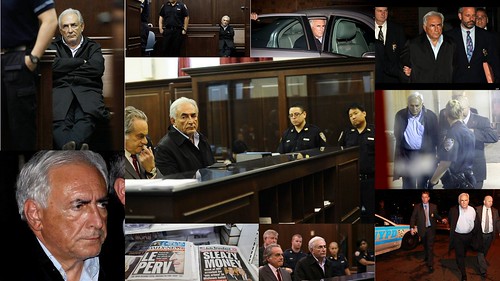
DSK facing... American Americanism?


Vince Boston from San Mateo, California comments on NYTimes:

Bonjour, mon ami's ! It is I, ze great sophisticated and elegant Dominque Strauss-Kahn, who always selects ze perfect wine. Oui, I had a bit of fun with a mere chambermaid...so what? What else are ze chambermaids there for? Ze problem is ze puritanical Americans...not moi ! I merely do what I and my fellow government bankers have been doing for years, and it is ME who is supposedly ze problem? I reject your puritanical American Americanism !

Me and my fellow $3,000/night international government bankers spend all day long raping poor countries on behalf of rich countries. When we tire of that, we switch to raping the working class inside each country on behalf of the ruling class who went to the right schools and have the right last names. After all, I am ze most ridiculous of all ze politicians in ze entire world, a stalwart leader of ze French “Socialist” Party.

Why, ever since I was born with my nursemaid feeding me Dom Perignon in my baby bottle, I have dedicated my life to helping the struggling working classes…like ze hotel maid last night. She was struggling…does she not realize I was helping her in her fight against ze rich exploitive well-connected ruling class ? Ungrateful wench !

What could be more natural for me and my good banking fellows than to switch to raping hotel maids at ze end of a long tiring work day ? I do whatever I want whenever I want to whoever I want ! Yes, yes, you may, how you say, succeed in locking me up in one of your puritanical puritan prisons. But it matters little. There are 50, 100, 1,000 more international government bankers waiting to take my place and continue with our sacred, important "work". It is truly a calling, not merely a “job”.

It could be that this man is sick and his known dependency was exploited by the professional handlers of the victim(?).

Indeed, growing popularity in France was construed as a risk not only for L’américain, our ever obliging friend at Élysée Palace, but also to US capitalism itself–see DSK’s murmurs about the need for an international alternative to the dollar based on the IMF's special drawing rights, or about increased state-level financial regulation.

Another interesting question that comes into focus is if DSK was indeed the best face of the (French) Left. The vanishing of the working class in the west (read, post-industrial economy myth temporarily sustained by off-shoring / delocalization) has made reaction to the anti-popular excesses of capitalism very difficult.

Fukushima, mon amour: Letter to the Readers of the Capitalism Saga

CapitalismCapitalism is itself an artifact, based on a fiction. Sooner or later, it runs out. Some of its plot elements are property, law, innovation, technology, obstinate individualism, entrepreneurship, growth, greed, corporate personhood, market as deus ex machina... We identify many of these as natural; in fact they have become second nature, but who's drawing this distinction anymore?

The social ordering role of grand narratives can be hardly overstated.  The Capitalism story has been so transformational a force that even a communitarian country like Japan could muster only 50 volunteers to risk their lives in limiting the scope of the fast spreading nuclear damage at Fukushima, not to mention how many weeks it had taken.*  Contrasting this to the Soviet response at Chernobyl, where 0ver 300 thousand people had been mobilized to contain the damage, is better left for the ethicist.** 

Besides filling the western world with stuff, capitalism has managed to achieve something even more remarkable, it puts the story from the opening paragraph between most and the real owners/handlers. In other words, capitalism has no customer support department, yet the few own and re-write it with legitimacy, if not impunity.  What has gone missing?  To name just one, the state as that entity greater than the sum of individuals in a country.  Indeed, where was the state after Katrina, BP oil spill, or at Fukushima, when corporate or natural disasters hit?  Please, don't confuse our political representatives for the state!  They use whatever is left out the state, i.e. the monopoly of violence, to legitimately hang on their side of POWER.  I also hope the reader won't think the state stood behind the big bank(er)s, for the same representatives put us, or the Irish, in that situation.  

To return to the main epic, a country like the US has been addressing the intrinsic limits of capitalism by hard work, of its own and then of the scores of immigrants, chance, or by externalizing its problems. We have had many an advantage at our disposal that a place like Japan or Germany could only dream of.

Japanese capitalism reached its limits a while back. Sitting on a big pile of money and running on inertia might have seemed as heroic. Then something like Fukushima happens in short sequence from the 2008 Crisis and the 2010 BP oil spill in the Gulf of Mexico. Not to mention all the petro-wars.

What's the meaning of this? For each his own. While Germany interrupted the operations at several nuclear power plants, Japan has signaled that it would not increase its reliance on nuclear energy as once planned. Closer to home, I expect Obama will pass the immigration law, but am apprehensive it's going to be another political hack and not necessarily a solution to our problems. One of our solvable problems, by virtue of a redesigned immigration system, would be the math education: grant work visa to math teachers and fill our classrooms with people whose knowledge and IQ would otherwise qualify them for running... banks.

Japan, I anticipate, will be the first one to turn the page away from Capitalism. Or at least away from its ferociously anti-civilization aspects--read, consumerism, growth... As for the energy problem, it should be rephrased as opportunity: stargazing will be again possible even in a Tokyo neighborhood.


______________
* With this occasion, I've come to better understand the Japanese communitarian values, which in the west are seen mostly with indulgence.  It must have been many a natural disaster that fused this people into what it is.
** Thinking that the international community, for the past 10 years, has not come up with the estimated billion dollars needed to consolidate the leaking and fast aging cover of the Chernobyl blown up reactor is even more indicative of the values ordering our world. 


Enjoy Capitalism

the view from our end


P050111PS-0210, originally uploaded by The White House.

Via Flickr:
President Barack Obama and Vice President Joe Biden, along with members of the national security team, receive an update on the mission against Osama bin Laden in the Situation Room of the White House, May 1, 2011. Seated, from left, are: Brigadier General Marshall B. “Brad” Webb, Assistant Commanding General, Joint Special Operations Command; Deputy National Security Advisor Denis McDonough; Secretary of State Hillary Rodham Clinton; and Secretary of Defense Robert Gates. Standing, from left, are: Admiral Mike Mullen, Chairman of the Joint Chiefs of Staff; National Security Advisor Tom Donilon; Chief of Staff Bill Daley; Tony Binken, National Security Advisor to the Vice President; Audrey Tomason Director for Counterterrorism; John Brennan, Assistant to the President for Homeland Security and Counterterrorism; and Director of National Intelligence James Clapper. (Official White House Photo by Pete Souza)

Dr Helen Caldicott: The Earth is in the Intensive Care Unit

Via Flickr:
See the "Dr Helen Caldicott: The Earth is in the Intensive Care Unit" video

This week we devote the entire episode to Dr. Helen Caldicott, one of the founders of Physicians For Social Responsibility (PSR). In this piece, edited by PepperSpray's Patricia Boiko, Dr. Caldicott talks of the nuclear issues and the health of the earth from the perspective of a healer/physician. PepperSpray collective members kept her in the viewfinder during on-air radio interviews in Seattle and accompanied her to the Washington meeting of PSR where she was the keynote speaker. Physicians for Social Responsibility an organization of 23,000 doctors committed to educating their colleagues and the public about the dangers of nuclear power, nuclear weapons and nuclear war. www.psr.orgAfter being instrumental in the formation of PSR in the US, Dr. Caldecott helped start similar medical organizations in many other countries. The international umbrella group (International Physicians for the Prevention of Nuclear War) won the Nobel Peace Prize in 1985. www.ippnw.org She also founded the Women's Action for Nuclear Disarmament, now Women's Action for New Directions (WAND) in the US in 1980. www.wand.org  Other professions took up the challenge of "social responsibility," and the 1980s and 90s saw an array of organizations such as Computer Professionals For Social Responsibility, each with their own focus.http://www.cpsr.orgBooks by Helen Caldicott referenced in the video:Nuclear Power Is Not the Answerhttp://books.google.com/books?id=iEVb...The New Nuclear Danger: George W. Bush's Military-Industrial Complexhttp://books.google.com/books?id=Diy9...War in Heaven: The Arms Race in Outer Spacehttp://books.google.com/books?id=FoJu..."Indymedia Presents" is a weekly public access program produced on behalf of the Seattle Independent Media Center (IMC) by PepperSpray Productions... now also a weekly podcast available at:http://indymediapresents.blip.tvhttp://miroguide.com/channels/1786Pubic Access producers, community screeners, and IMCs
are encouraged to screen or air "Indymedia Presents." To obtain the show on a regular basis, please contact us at pepperspray@riseup.net.Related Free Speech Websites:Independent Media Centerhttp://www.indymedia.org/en/index.shtmlIndymedia NewsRealhttp://www.newsreal.indymedia.orgFree Speech TV:http://www.freespeech.orgDemocracy Now!http://www.democracynow.orgThis video was originally shared on blip.tv by Pepperspray Productions with a Creative Commons Attribution-NonCommercial-NoDerivs license.


Unsafe at Any Dose
Sydney, Australia

SIX weeks ago, when I first heard about the reactor damage at the Fukushima Daiichi plant in Japan, I knew the prognosis: If any of the containment vessels or fuel pools exploded, it would mean millions of new cases of cancer in the Northern Hemisphere.

Many advocates of nuclear power would deny this. During the 25th anniversary last week of the Chernobyl disaster, some commentators asserted that few people died in the aftermath, and that there have been relatively few genetic abnormalities in survivors’ offspring. It’s an easy leap from there to arguments about the safety of nuclear energy compared to alternatives like coal, and optimistic predictions about the health of the people living near Fukushima.

But this is dangerously ill informed and short-sighted; if anyone knows better, it’s doctors like me. There’s great debate about the number of fatalities following Chernobyl; the International Atomic Energy Agency has predicted that there will be only about 4,000 deaths from cancer, but a 2009 report published by the New York Academy of Sciences says that almost one million people have already perished from cancer and other diseases. The high doses of radiation caused so many miscarriages that we will never know the number of genetically damaged fetuses that did not come to term. (And both Belarus and Ukraine have group homes full of deformed children.)

Nuclear accidents never cease. We’re decades if not generations away from seeing the full effects of the radioactive emissions from Chernobyl.

As we know from Hiroshima and Nagasaki, it takes years to get cancer. Leukemia takes only 5 to 10 years to emerge, but solid cancers take 15 to 60. Furthermore, most radiation-induced mutations are recessive; it can take many generations for two recessive genes to combine to form a child with a particular disease, like my specialty, cystic fibrosis. We can’t possibly imagine how many cancers and other diseases will be caused in the far future by the radioactive isotopes emitted by Chernobyl and Fukushima.

Doctors understand these dangers. We work hard to try to save the life of a child dying of leukemia. We work hard to try to save the life of a woman dying of metastatic breast cancer. And yet the medical dictum says that for incurable diseases, the only recourse is prevention. There’s no group better prepared than doctors to stand up to the physicists of the nuclear industry.

Still, physicists talk convincingly about “permissible doses” of radiation. They consistently ignore internal emitters — radioactive elements from nuclear power plants or weapons tests that are ingested or inhaled into the body, giving very high doses to small volumes of cells. They focus instead on generally less harmful external radiation from sources outside the body, whether from isotopes emitted from nuclear power plants, medical X-rays, cosmic radiation or background radiation that is naturally present in our environment.

However, doctors know that there is no such thing as a safe dose of radiation, and that radiation is cumulative. The mutations caused in cells by this radiation are generally deleterious. We all carry several hundred genes for disease: cystic fibrosis, diabetes, phenylketonuria, muscular dystrophy. There are now more than 2,600 genetic diseases on record, any one of which may be caused by a radiation-induced mutation, and many of which we’re bound to see more of, because we are artificially increasing background levels of radiation.

For many years now, physicists employed by the nuclear industry have been outperforming doctors, at least in politics and the news media. Since the Manhattan Project in the 1940s, physicists have had easy access to Congress. They had harnessed the energy inside the center of the sun, and later physicists, whether lobbying for nuclear weapons or nuclear energy, had the same power. They walk into Congress and Congress virtually prostrates itself. Their technological advancements are there for all to see; the harm will become apparent only decades later.

Doctors, by contrast, have fewer dates with Congress, and much less access on nuclear issues. We don’t typically go around discussing the latent period of carcinogenesis and the amazing advances made in understanding radiobiology. But as a result, we do an inadequate job of explaining the long-term dangers of radiation to policymakers and the public.

When patients come to us with cancer, we deem it rude to inquire if they lived downwind of Three Mile Island in the 1980s or might have eaten Hershey’s chocolate made with milk from cows that grazed in irradiated pastures nearby. We tend to treat the disaster after the fact, instead of fighting to stop it from happening in the first place. Doctors need to confront the nuclear industry.

Nuclear power is neither clean, nor sustainable, nor an alternative to fossil fuels — in fact, it adds substantially to global warming. Solar, wind and geothermal energy, along with conservation, can meet our energy needs.

At the beginning, we had no sense that radiation induced cancer. Marie Curie and her daughter didn’t know that the radioactive materials they handled would kill them. But it didn’t take long for the early nuclear physicists in the Manhattan Project to recognize the toxicity of radioactive elements. I knew many of them quite well. They had hoped that peaceful nuclear energy would absolve their guilt over Hiroshima and Nagasaki, but it has only extended it.

Physicists had the knowledge to begin the nuclear age. Physicians have the knowledge, credibility and legitimacy to end it.

Helen Caldicott, a founder of Physicians for Social Responsibility, is the author of “Nuclear Power Is Not the Answer.”

I wish all of US LUCK!

There are no spontaneous revolutions. Popular anger needs coordination, channeling, resources.

No outsider would have dared trouble the waters in a place like Egypt.  The US would have eventually found out and the whole thing become a casus belli.

The security apparatus in a place like Egypt could have put down any manifestation in a matter of hours.  The Egyptian Army must have been in.

If all goes well, Capitalism gets a new lease on life, long live democracy for capital!

Meanwhile, the West should hold together, yet the US will re-discover (the virtues of) nylon.

Officially, I am happier

This is a time we'll remember.  It's taken history a little over 20 years to re-expose the cracks in our world system, just as they were before the cold war froze themapt metaphor indeed.  Except that this time, it takes the news much less to reach that many more.   

In November we had Wikileaks/Cablegate, now we have Tunisia and Egypt, episodes of violence of one type or another.  They all challenge the status qvo, which has its own defenders.  For one, there are the current elites, who'd been able to stage a smooth show until the 2008 Crisis, or until the most recent onset of the crisis in 2008.  Up until 2008, genetically modified food and cheap Chinese imports had kept the hoi polloi climbing the pyramid of growth in this or that market, the up and coming could still find a place at the lower tables, whereas the true elites were taxing the addiction of democracies to credit financed pyramidal-growth.

The underlined text is the least exposed, topmost, yet more interesting, part of a 3-layered machinery whereby to each his own.  The low strata provide the labor and standing army in exchange for a chance at The American Dream, the idea that tomorrow ought to be better than today, given that you play by the rules, regardless of the initial conditions.  It's a social compact of sorts to which most still subscribe to, in form if not in spirit.  In other parts of the world with comparable per capita/GDP metrics, the compact is not framed in such probabilistic terms but actual indemnification--this also goes by the name of welfare state, a creation of contractual parties enlightened by experience.  So until 2008, the American Dream had been in sight for many, though people in places like Ohio may take exception--for them, the Crisis started in 2000-2001.  We were conditioned to measure our betterment in terms of stuff acquired on credit, but that's part of the status qvo ante.  When the magic behind credit is questioned, we all look at a house of cards.

What was the top stratum doing?  They have privatized just about everything, including war, the means to persuade the elected few and, most importantly, the money supply.  Some could argue that The Fed has been private since its inception, for how else to keep the democratically elected populist from printing more money?  To which I'd say, there used to be rules restricting self-serving abuse by the money handlers themselves.  Also, more or less functioning markets were supposed to operate and keep the whole financial industry efficient, if not effective, at allocating the money resource in the economy.  To return to privatizing everything, it increases liquidity, reduces waste, generates commissions; what's not to like about it?  Indeed, it puts The American Dream on the market autopilot.  Except that for whatever reasons, and they vary from human nature to the late stage of our capitalism, the money handlers have gone far beyond taxing our addiction for cheap credit into generating virtual capital, orders of magnitude in excess to the real economies of the world combined, and transactions for their own sake.  In other words, increased money supply and transactions leading to more commissions--if measured by the banksters' bonuses alone, quite an expensive addiction to have.  So, those private entities that were supposed to keep the democratic government fiscally honest must have hijacked the game along the way.  Never mind the role of the state, read something about regulatory capture and the cycle is complete.

To open a parenthesis, the 2008 Crisis has reached even those whose money supply has not been privatized.  Indeed, they needed growth for an aging population just about as much as we needed for our pyramids, so they had to join in while the music was playing.  Who doesn't find it ironic that in Ireland, for example, the population has to suffer because of imprudent private banks' lending practices and not because of some over-generous welfare scheme?  These are all details, which the little people may someday put together into a call to action, unless real reform is undertaken.  So far, we've been headed where the theorists of socio-economics have told as for about 160 years.  Can capitalism regenerate itself?  Better yet, what will it morph into?      

As I wrote here in the past, downward adjustment is on the books for us.  Obama's recently calling for increased competitiveness means that our individual incomes would go down and we can kiss goodbye whatever is left of the welfare state; let's just forget about the alternative of all turning into neurosurgeons or microprocessor designers.(*)  An oil crisis brought about by street movements in the Arab world can be a good external diversion to spring the whole west back into action on behalf of capitalism and value$.(**)  Indeed, how do you defy the cycle if not by some expansion?  If the financial expansion has run its course, what's left?  We should also keep in mind the lesson of the late British Empire, at twilight military expansionism speeds things up instead of allowing the belligerent to choose solutions.  We cannot bankroll Pax Americana far into the 21 century. 

Yes, I am all for supporting the consequences of our pyramidal dreams, meaning downward corrections and/or inflation, but so far I find the idea of justice lacking in the process.  Reform ought to be real and aimed at the practices of the top layer, just as much if not more than the base.  Otherwise, officially I am told that 2011 will have been already better!

_______________

(*) Lawrence Summers, former Obama's officially economy expert, has given an interview about the way he sees the future; here's an excerpt from NYTimes
The key to higher employment, he said, is increasing the demand for the goods and services produced by American companies. “You don’t hire more waiters unless the waiters you have in your restaurants have more work than they can handle,” he said. “There’s a continuing shortage of demand, and that’s the root cause of unemployment. It’s the root cause of low-capacity utilization…What you need to do is have more output with more people, and the way you have more output with more people is you need people who want to buy that output, and that’s why it comes back to demand.”
This should give us all an indication of what competitive means to our leaders, waiter-level incomes/benefits.  As well, we won't come out of unemployment unless willing to get such jobs. That may well be so for us, what about THEM?  THOSE who restart the economy of waiters-based models.
(**) The events in Tunisia and Egypt are most puzzling.  I don't believe in street movements beyond drama and opportunity (lost or made).   The west has grown too dependent on oil in its own terms, to which the US added dollar-denominated trade.  The standing question of the moment is cui prodest, or what's behind?  As for the role of (internet) technology in democratizing, allow me to take exception.  Moreover, the voting experiment in Palestine yielded populist-Islamics, not the garden variety politician our elite has been so effective at co-opting.  

As for the "value$" in question, truth be told, the might dollar has turned us oblivious to many of our deficiencies--see for example the reflex call for money each time we are faced with a problem--thus we stopped learning.  The west has gone along, more or less (see the 1971 decoupling of the dollar from gold), for all kinds of reasons, e.g., red scare, security clients, markets, etc.  All in all, there has been no one to fundamentally question what we were doing.  I would not take this as guarantee for future behavior.    

They Have Spoken

Two recent articles, in Foreign Affairs and HBR, feature the views of two Harvard professors about the road ahead.  I commented on each one of them, and conclude here that the kind of intellectual leadership that has brought us where we are, through 2008, is alive and well.  Have a look for yourself, and draw your own conclusions!

------------8<-------------------------------------------------
The Future of American Power
Dominance and Decline in Perspective
Joseph S. Nye Jr.
Summary: It is currently fashionable to predict a decline in the United States' power. But the United States is not in absolute decline, and in relative terms, there is a reasonable probability that it will remain more powerful than any other state in the coming decades.
JOSEPH S. NYE, JR., is University Distinguished Service Professor at Harvard University. Parts of this essay are drawn from his forthcoming book, The Future of Power (PublicAffairs, 2011).

Yes, our perceptions about the future have gone up and down through our history, yet people's lives went also up and down unless they counted themselves among the lucky/Ivied. Each time our common fortune went up, it followed some long period of pain and was the result of some major transformation.

Professor Nye doesn't say a word about the type of transformation ahead. He talks generalities and quotes selectively in support of his argument. For example, he counts us as leaders in biosciences, but then why doesn't he look at the flip-side, to the requirement for this? A lousy and expensive medical system whose results are half as good, for twice the money, as in other developed economies. Surely, the argument could be extended to his dear universities--compare $50k to quasi-free in annual college tuition. Oh, his list of where we are #1 is almost comprehensive, for if he added military and financial innovation, the list would have been complete.

What do these observations make me think?

1) That our being #1 cannot be sustainable under status qvo, even in a reduced number of areas. Indeed, for example, an overburdened and socially under-performing medical system cannot be counted on to keep going forever.  The author's prescriptions amount to folklore. 
2) That Professor Nye may be, well, a bit out of touch. I guess, they don't call some the Boston Brahmin for nothing...

No, China won't go up and higher forever; Yet, a question lost on the author is, How big China's economy needs to be to turn it into a challenger? Going into GDP or per capita comparisons is not as relevant as the author makes it sound. Switzerland may get higher grades on many dimensions, yet it is hardly a menace for the US.

Nor will we reach the bottom in free fall. More likely to happen is a world choosing between our type of capitalism and state-capitalism. If we overcome the political gridlock (à la Fallows/Nye), the two types of capitalism will converge. Meanwhile, texts like this are meant to put the middle class to sleep.

------------8<-------------------------------------------------
The Big Idea: Creating Shared Value
by Michael E. Porter and Mark R. Kramer
The capitalist system is under siege. In recent years business increasingly has been viewed as a major cause of social, environmental, and economic problems. Companies are widely perceived to be prospering at the expense of the broader community.

Alas, this has been written by:

* E. Porter is the Bishop William Lawrence University Professor at Harvard University. He is a frequent contributor to Harvard Business Review and a six-time McKinsey Award winner.
* R. Kramer cofounded FSG, a global social impact consulting firm, with Professor Porter and is its managing director. He is also a senior fellow of the CSR initiative at Harvard’s Kennedy School of Government.

For the reader skeptical of my comment, let me quote from the article:

"Shared value is not social responsibility, philanthropy, or even sustainability, but a new way to achieve economic success. It is not on the margin of what companies do but at the center. We believe that it can give rise to the next major transformation of business thinking."

How many times has it been that we've heard such calls? Each time, they are similarly worded and meant to supplant government responsibility&action for a clean environment, sustainable societies and so on.

Now, allow me to state what the problem is with this: I have little control over how businesses operate, for they are subject to their institutional imperative of making short-term money. Arguably, the government is responsible to me. Do you see the problem? I can do little to nothing to influence business, I can vote every electoral cycle to keep the government honest. For those countering that we vote for business everyday with our wallet, I'd say, not anymore when you are in debt and/or the business in question is a monopoly. Moreover, if the behavioral requirement is not normative, as in a law subjecting all players to the same constraint, there will always be businesses trying to get advantage of not respecting otherwise self-generated social objectives.

So, the rule must be the same for all businesses, and the enforcer should be from the sphere of government/society, not businesses themselves.

------------8<-------------------------------------------------

Yes, I know, we don't do government, lest someone calls us socialist, but then why all the talk about business-this and business-that?  To pacify us while waiting for the next bubble?  If so, why not stop sucking on the damn rubber?
covering mirrors

The 2nd installment of wikileaks, Cablegate, has been partially released, as in 1/000.

The story behind the whole data-spill seems to have been initiated by Bradley Manning, 22, one of those we like to cheer about in terms such as our brave men and women serving in harm's way. Until he was locked up in solitary confinement, Manning used to be an intelligence analyst with the Army, outside Baghdad. In his own words, the facts were: "I would come in with music on a CD-RW labeled with something like 'Lady Gaga' … erase the music … then write a compressed split file. No one suspected a thing ... [I] listened and lip-synched to Lady Gaga's Telephone while exfiltrating possibly the largest data spillage in American history." He said that he "had unprecedented access to classified networks 14 hours a day 7 days a week for 8+ months." He even anticipated some reactions, "Hillary Clinton and several thousand diplomats around the world are going to have a heart attack when they wake up one morning and find an entire repository of classified foreign policy is available, in searchable format, to the public ... Everywhere there's a US post, there's a diplomatic scandal that will be revealed. Worldwide anarchy in CSV format ... It's beautiful, and horrifying." Stated motivation: "Information should be free. It belongs in the public domain."

Now, how symptomatic is this for the state of our empire, er, nation? Did we need a 22-year old to come and show how ugly empire is? Below are what can be two answers:

Dovid
Monsey, NY

This is what I call treason!
Recommended by NYTimes 237 Readers


Diana
New York

To Commenter #4, [Dovid] I'd say, No, compiling and releasing documents, 'none of which was marked top secret,' is not treason, it's democracy in action.

For a truly treasonous act, see the outing of an undercover CIA operative, Valerie Plame, who had worked for years setting up very successful false operation directed at uncovering 'weapons of mass destruction.' Her husband told the truth about the lies being that would justify getting into war, lies told by very powerful and deeply unpatriotic war profiteers, and she was 'outed' in revenge. She--and our country--continue to pay the price; the war profiteers continue to go free.
Recommended by 371 NYTimes Readers (highest number of recommendations)

I'd posit that running a large and complex system like the US, implies effective and efficient control mechanisms.  Effective as in get the job done, efficient as is make those controlled do the control themselves.  Efficiency comes wrapped in all the talk about our being a nation of laws, fighting for human rights and justice for all.  So, is it that a smart young man, driven by patriotism, enlists with the Army, yet his self-control breaks when he gets deployed and sees our relations with the world out there being so different from what we espouse at home?  

From a slightly different angle, let's review all the above from a 1992-perspective in Hollywood, a year after the official demise of the USSR due to our upholding higher values. You'll recognize Colonel Nathan R. Jessep, from 'A Few Good Man' in the You Can't Handle the Truth-moment.


To each his own, but considering the mounting problems we face, both internally and internationally, I'm afraid that not wanting to know the truth is akin to covering mirrors in the house after someone died.  It may be efficient but hardly effective.  
______________________________________________________

12/12/2010 Update
Whatever one may think of Bradley Manning, who took an oath when joined the Military, the situation with Julian Assange is a whole different matter.  Being on offensive will erode our standing, it's about principle not about any one individual.  We should accept OUR mistake(s), e.g. of not setting up proper systems, and leave Assange in peace. The earlier we do this, the less painful for all involved. This is neither the way to set an example, nor the type of example you want to set.

Popular Posts