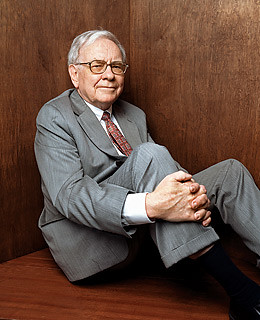
Via Flickr:
Warren Buffett now says that the backlash from the huge spending that made the recovery possible maybe just around the corner. Writing an Op-ed piece in New York Times, he says: In nature, every action has consequences, a phenomenon called the butterfly effect.
Stop Coddling the Super-Rich
By WARREN E. BUFFETT
Omaha
OUR leaders have asked for “shared sacrifice.” But when they did the asking, they spared me. I checked with my mega-rich friends to learn what pain they were expecting. They, too, were left untouched.
While the poor and middle class fight for us in Afghanistan, and while most Americans struggle to make ends meet, we mega-rich continue to get our extraordinary tax breaks. Some of us are investment managers who earn billions from our daily labors but are allowed to classify our income as “carried interest,” thereby getting a bargain 15 percent tax rate. Others own stock index futures for 10 minutes and have 60 percent of their gain taxed at 15 percent, as if they’d been long-term investors.
These and other blessings are showered upon us by legislators in Washington who feel compelled to protect us, much as if we were spotted owls or some other endangered species. It’s nice to have friends in high places.
Last year my federal tax bill — the income tax I paid, as well as payroll taxes paid by me and on my behalf — was $6,938,744. That sounds like a lot of money. But what I paid was only 17.4 percent of my taxable income — and that’s actually a lower percentage than was paid by any of the other 20 people in our office. Their tax burdens ranged from 33 percent to 41 percent and averaged 36 percent.
If you make money with money, as some of my super-rich friends do, your percentage may be a bit lower than mine. But if you earn money from a job, your percentage will surely exceed mine — most likely by a lot.
To understand why, you need to examine the sources of government revenue. Last year about 80 percent of these revenues came from personal income taxes and payroll taxes. The mega-rich pay income taxes at a rate of 15 percent on most of their earnings but pay practically nothing in payroll taxes. It’s a different story for the middle class: typically, they fall into the 15 percent and 25 percent income tax brackets, and then are hit with heavy payroll taxes to boot.
Back in the 1980s and 1990s, tax rates for the rich were far higher, and my percentage rate was in the middle of the pack. According to a theory I sometimes hear, I should have thrown a fit and refused to invest because of the elevated tax rates on capital gains and dividends.
I didn’t refuse, nor did others. I have worked with investors for 60 years and I have yet to see anyone — not even when capital gains rates were 39.9 percent in 1976-77 — shy away from a sensible investment because of the tax rate on the potential gain. People invest to make money, and potential taxes have never scared them off. And to those who argue that higher rates hurt job creation, I would note that a net of nearly 40 million jobs were added between 1980 and 2000. You know what’s happened since then: lower tax rates and far lower job creation.
Since 1992, the I.R.S. has compiled data from the returns of the 400 Americans reporting the largest income. In 1992, the top 400 had aggregate taxable income of $16.9 billion and paid federal taxes of 29.2 percent on that sum. In 2008, the aggregate income of the highest 400 had soared to $90.9 billion — a staggering $227.4 million on average — but the rate paid had fallen to 21.5 percent.
The taxes I refer to here include only federal income tax, but you can be sure that any payroll tax for the 400 was inconsequential compared to income. In fact, 88 of the 400 in 2008 reported no wages at all, though every one of them reported capital gains. Some of my brethren may shun work but they all like to invest. (I can relate to that.)
I know well many of the mega-rich and, by and large, they are very decent people. They love America and appreciate the opportunity this country has given them. Many have joined the Giving Pledge, promising to give most of their wealth to philanthropy. Most wouldn’t mind being told to pay more in taxes as well, particularly when so many of their fellow citizens are truly suffering.
Twelve members of Congress will soon take on the crucial job of rearranging our country’s finances. They’ve been instructed to devise a plan that reduces the 10-year deficit by at least $1.5 trillion. It’s vital, however, that they achieve far more than that. Americans are rapidly losing faith in the ability of Congress to deal with our country’s fiscal problems. Only action that is immediate, real and very substantial will prevent that doubt from morphing into hopelessness. That feeling can create its own reality.
Job one for the 12 is to pare down some future promises that even a rich America can’t fulfill. Big money must be saved here. The 12 should then turn to the issue of revenues. I would leave rates for 99.7 percent of taxpayers unchanged and continue the current 2-percentage-point reduction in the employee contribution to the payroll tax. This cut helps the poor and the middle class, who need every break they can get.
But for those making more than $1 million — there were 236,883 such households in 2009 — I would raise rates immediately on taxable income in excess of $1 million, including, of course, dividends and capital gains. And for those who make $10 million or more — there were 8,274 in 2009 — I would suggest an additional increase in rate.
My friends and I have been coddled long enough by a billionaire-friendly Congress. It’s time for our government to get serious about shared sacrifice.
Warren E. Buffett is the chairman and chief executive of Berkshire Hathaway.
Showing posts sorted by relevance for query tax. Sort by date Show all posts
Showing posts sorted by relevance for query tax. Sort by date Show all posts
The Greenback Effect - WARREN BUFFETT

On Obama's tax Plan
Paying taxes is a suckers' game for many. Too often, big money is being spent on tax avoidance schemes, which in turn distort behavior. Apparently, some individuals cannot think of what it takes to run modern states, while corporations have become states within states.
Our presidential hopefuls make all kinds of tax-related promises that are either unrealistic or incompletely specified. Even if McCain were to win, he could only raise taxes. Obama has come out as favoring tax-increases for those families making more than $250,000/year. Since Obama appears to have better chances to win, I will quote a couple of tax-related comments pertaining to his tax plan:
Our presidential hopefuls make all kinds of tax-related promises that are either unrealistic or incompletely specified. Even if McCain were to win, he could only raise taxes. Obama has come out as favoring tax-increases for those families making more than $250,000/year. Since Obama appears to have better chances to win, I will quote a couple of tax-related comments pertaining to his tax plan:
1) I'm a Democrat and an Obama supporter -- a volunteer, in fact. I am also a salaried professional, married to Joe the construction manager. Together, we earn about $250,000 a year, after deductions, and therefore will be paying higher taxes under Obama's tax plan. This even though we live in the NYC metro area, where the cost of living is 2.5 times the national average. That means that our income has the purchasing power of $100,000 in Podunk. We ain't starving, but neither are we Mr. & Mrs. Richie the Hedge Fund Manager.
My point is that Obama's plan will in fact impact the urban, professional middle class. Most of us are voting for him, but let's be honest; we are paying high taxes already here in Westchester County, plus high energy costs, plus high health care costs, and the extra $3,000 or so per year that Obama's plan will cost a family in my income bracket will not come easily.
I wish that Obama would include a "cost of living" adjustment in his tax plan, so that middle-class professionals in big cities wouldn't take a hit. On the other hand, if I have to sacrifice so that Richie finally pays his share, then I'll bite the bullet.— KT, Chappaqua, NY
2) My husband and I have worked hard over the course of our careers. Now that we are in our late 50s, we are mature in our professions and in our earning capacities. After many years of post-graduate education, we each attained the credentials necessary for our respective professions, and we have each subsequently put in countless hours (and immeasurable passion) to serve, in his case, patients, and, in my case, clients. We net more than $250,000 annually. Although we are now worried about the value of our investments, we are still looking forward to a comfortable retirement in the next decade.
While we don't particularly enjoy paying taxes, we do enjoy being citizens of the United States. We do expect to contribute to the education, infrastructure, public health, social welfare, safety, and culture of the country we live in. We do want to do our part to insure its future. So, while we may sigh when we write checks to the IRS, we also take some satisfaction in the belief that we are integral to the success of our country. Moreover, because we can afford to pay a larger share of our income than others can, we expect to do so.
Regardless of our professional success, however, we still are limited in our income potential by our relying principally on reimbursement for our labor. There are many others in the over $250,000/year category with incomes much greater than ours. There are many whose earnings come from their investments or their executive positions enabling them to partake of large shares of corporate earnings. Fairness requires that these individuals pay even greater amounts/percentages of their income than those of us who are essentially high-earning workers do. The tax rate needs to continue to slide upward, for top incomes go way, way, way above $250,000 annually. Those corporate executives who take millions in cash, bonuses, and stocks do not even breathe the same air as my husband and I. Their tax rate has to be greater than ours. In the tax realm, that's all I ask of Obama when he takes over the reins of this country, which he will do, and not a moment too soon.— Shelley, Santa Barbara
For the middle of the road family of professionals, I would say, expect to pay about 10 - 15 percentage points more in taxes. In other words, a 30% rate will go to about +40%. And, judging by the way Democrats on Capitol Hill voted for all financial issues, I would not hold my breath on the points raised in the above two comments, unless one really believed in transformational presidencies.
the voice of big business
Especially at a time like this, views from the commanding heights of American business are a necessity.
Ivan G. Seidenberg, Chairman of the Board and Chief Executive Officer
Washington, DC - June 22, 2010
As Delivered
[Introduction by David Rubenstein, President, Economic Club of Washington.]
Thank you, David, and good afternoon, everyone. Thank you for the very nice introduction. It's very nice to be here this afternoon. The Economic Club of Washington stands at the intersection between policy and business, which is where my Business Roundtable colleagues and I spend a good deal of our time these days. Based on your invitation list I see you've had a number of business leaders here recently to give their prescriptions for putting the U.S. back on the path to growth.
So in my remarks this afternoon I will try to add to this same conversation today. But first, I'd like to tell you a bit about Verizon and the enormously exciting industry we're in.
Before I start though, I might be the only speaker to encourage you to stay on your Blackberries. It's good for business.
Today, almost 2 billion people - about a quarter of the world's population - are connected to the Internet. Twice that many - 4 billion people - have mobile phones, which are themselves becoming smarter and more connected every day. On Verizon's networks alone, we carry more than 1.7 billion text messages, 50 million picture and video messages, 1 billion phone calls, 400 million emails and the equivalent of 4 million full-length movies - all in a single day.
Verizon invests some $17 billion a year to put ourselves in the center of this expanding marketplace.
We operate Internet backbone networks that serve as the digital trade routes for the global economy. We're reinventing our legacy backbone telephone networks around fiber technology capable of delivering 100-megabit capacity directly to customers' homes. In wireless, we operate 3G networks across the country. Later this year, we'll start to roll out our fourth-generation wireless network, which will increase data speeds by up to 10 times and initiate the era of the "Internet of things." Soon, wireless will be embedded in everything we touch, infusing intelligence into all our systems and presenting us with a whole new way to run a home or an enterprise, or even a country.
When it comes to innovation in communications, the U.S. has a clear, decided edge. The smart phone revolution is centered in the U.S. The creation of tens of thousands of wireless applications is a U.S. phenomenon. Our 4G LTE networks - 4th generation networks - will leapfrog the world in wireless. Verizon alone has deployed more fiber-to-the-home than all the countries of Europe, combined. And a new ecosystem of devices, applications and operating systems is coming together around these platforms for innovation, spawning new businesses and driving our industry forward.
America's communications companies have made a big bet on this vision of the future, investing around $130 billion in 2009 alone. Last year, total investment in information and communications technology accounted for an astonishing 43 percent of all non-structural capital investment in the U.S. And while private investment in general fell by almost 23 percent from 2006 to 2009, communications investment rose by almost 9 percent over the same period.
These investments are a major engine of our economy. Businesses report that every dollar invested in Internet technology creates four dollars of value in return. Robert Crandall of Brookings says broadband investment can produce more than half a million new jobs over the next five years, while creating new demand for computers, software, network equipment and applications. And on a global basis, one study estimates the annual economic benefits of the commercial Internet to be $1.5 trillion - more than the global sales of medicine, investment in renewable energy and government R&D investments, all combined.
Broadband, wireless and global IP are at the heart of American competitiveness. At Verizon, we're excited about the future and believe - fervently - that our industry can continue to play a big role in addressing the challenges we face as a country.
Now, it's important that we not throw sand in the gears of this critical growth engine. You may have seen that last week the Federal Communications Commission began a proceeding to establish a new regulatory regime for broadband, which would impose old utility-style regulation on the Internet. We are very concerned that, in attempting to address legitimate issues about access to the Internet, the FCC has proposed basically an unimaginative and overbearing set of rules that essentially tries to retrofit a new industry into an old framework and expand their regulatory reach well beyond what is necessary. As we've said - and as we've demonstrated - communications companies will continue to work with the Commission and the other players in the Internet space to protect customers and ensure an open and robust broadband environment. The FCC's current course of action will really do little to achieve those objectives, but rather will cause uncertainty in the marketplace, create disincentives for investment and make one of the true success stories of the American economy less competitive on the global stage.
***
Now, Competitiveness is also on the minds of the 170 members of the Business Roundtable, which, as David said, I am the chairman. Together, Business Roundtable companies generate more than $6 trillion in revenues and employ more than 12 million people. We account for 60 percent of all corporate taxes, 60 percent of all charitable contributions, and one-half of all private R&D spending in the U.S. Our market capitalization is one-third of the total value of the stock market, and we pay some $167 billion in dividends to individual investors, pension funds and retirement accounts. For every person employed by a BRT company, there are two more employed by the medium and small businesses that supply the goods and services that we need to keep our businesses running.
So obviously, the companies of the Business Roundtable have a huge stake in the success of the American economy. We create jobs all along the food chain. We invent and manufacture and sell the things consumers need. And we have the technology, expertise and capital capacity to play a huge role in contributing to our nation's economic growth.
It should be equally obvious that our collective resources are not being sufficiently engaged.
The BRT has accepted our responsibility as partners in moving the country forward. My colleagues and I have worked closely with policy-makers across the political spectrum on matters from health care to trade and tax policy to energy and climate change. But frankly, we have become somewhat troubled by a growing disconnect between Washington and the business community that is harming our ability to expand the economy and grow private-sector jobs in the U.S. We see a host of laws, regulations and other policies being enacted that impose a government prescription of how individual industries ought to be structured, rather than produce an environment in which the private sector can innovate, invest and create jobs in this modern global economy.
In our judgment, we have reached a point where the negative effects of these policies are simply too significant to ignore.
In the search for short-term revenue fixes, we're doing long-term damage to growth.
By reaching into virtually every sector of economic life, government is injecting uncertainty into the marketplace and making it harder to raise capital and create new businesses.
Meanwhile, without a sufficiently comprehensive focus on growth and jobs, our unemployment rate continues to hover close to 10 percent. The CBO says debt will rise to 90 percent of G.D.P. in 10 years. And last month's job report showed the private sector creating only 41,000 jobs, a figure the Economic Policy Institute says is "nothing closely resembling the job growth needed to dig us out of our very deep hole."
So, from our perspective, it's time to refocus public policy on creating the conditions that will drive private-sector jobs.
Recently, in response to a request from Dr. Peter Orszag of the OMB, the Business Roundtable and the Business Council polled our members about laws, rules and regulations that are inhibiting growth. We summarized our concerns in an extensive report, which we have already delivered to OMB, and I am very much encouraged that the Administration has already reached out to us to set up a process for discussing recommendations and ideas and set the discussion for the future.
From the avalanche of examples included in our OMB submission, let me share some specifics in three categories: taxes, trade and financial reform.
***
One message we heard loud and clear from our members is that the current U.S. tax system is a major impediment to international competitiveness. Our corporate tax rate is the second highest among 30 OECD nations. We're one of only five OECD countries to tax companies on worldwide income. Moreover, since 1990 every other OECD country has lowered its corporate tax rates, while the U.S. is going in somewhat the opposite direction.
Recently, the House passed a tax extender bill containing several provisions that raise taxes on multinational companies. We believe these actions would impair America's competitiveness and harm American workers. Multinational companies account for 63 million jobs, nearly half of U.S. exports and most of the productivity gains in the U.S. economy - facts that need to be taken into account when making tax policy.
Sometimes the problem isn't too much action, but too little. Dividend taxation is one example. Next year, unless the Congress takes action, the tax on dividends is scheduled to rise to that of ordinary income, with rates topping out at 39 percent. On its face, this may seem to be an easy revenue-raising idea. But at a time of extreme market volatility, do we really want to disadvantage stable, dividend-paying stocks - and the retirement funds and millions of long-term dividend investors who depend on them?
Another area in which we fear good intentions will have unintended consequences is financial reform. Clearly, the government has an interest in ensuring a stable financial system, efficient capital markets and ethical and transparent business practices. That's why the BRT completely supports the idea of financial reform. However, we believe some of the current proposals with respect to derivatives and proxy access go a step too far, imposing one-size-fits-all solutions on highly dynamic and diverse businesses. Instead of focusing on the inputs to a transparent and efficient financial system, the proposed reforms will increase risk and volatility at a time when just the reverse is required.
We also see a disconnect between objectives and actions in the area of international trade. The Administration has indicated its intent to double U.S. exports over the next five years, recognizing that with 75 percent of the world's purchasing power and 87 percent of its growth coming from outside the U.S., an export-focused trade policy will grow jobs here at home.
The Business Roundtable agrees wholeheartedly with this goal. But while the European Union is moving ahead in implementing free trade agreements, we have seen very little movement on pending agreements with Colombia, Panama and South Korea to name a few. Nor have we made it a priority to seek more expansive trade negotiating authority to keep up with foreign competitors.
We also could do more to make America a more attractive destination for foreign direct investment, which fell by nearly 60 percent from 2008 to 2009. Now, to be fair, much of that is due to the global recession. But the truth is, the U.S. share of global capital inflows has been declining for decades. A new survey by Ernst & Young found that, whereas 48 percent of global investors saw North America as a desirable location for investment in 2006, by 2010 this percentage had fallen to just 22 percent. The most attractive market is China, favored by 39 percent. To quote the Ernst & Young study, we're competing for capital in a "new multi-polar world"in which investors can shop the globe for "growth, talent, technology and productivity."
We need to make sure that the U.S. isn't a fly-over zone when it comes to international trade and investment.
***
These are just a few of the issues we have laid out in our response to Dr. Orszag's request. The full report contains literally hundreds of separate actions and decisions that, taken together, create an increasingly hostile environment for investment and job creation here in this country.
As I said before, it would be better to re-focus public policy on creating private-sector jobs. In general, among BRT CEOs there is remarkable consensus around a few fundamental pillars to achieve this growth.
First, we need tax policies that promote capital formation. As Fred Smith, CEO of FedEx, noted recently in the Wall Street Journal, the correlation between domestic job growth and business investment is very strong. He calls for an extension of accelerated depreciation tax provisions as a way to give an immediate boost to the economy. According to the Institute for Policy Innovation, every $1 of tax cuts devoted to accelerated depreciation generates about $9 of growth in G.D.P.
Second, we need to increase exports and improve our international competitiveness. Here, the rhetoric from policy-makers has been right but the actions need to be better aligned through an emphasis on trade agreements, corporate tax reform and other initiatives to put us on more competitive footing internationally.
Third point, we need infrastructure investment to create jobs and build the platforms for 21st century growth. Jim Owens, the Chairman and CEO of Caterpillar, points out that since the 1970s, U.S. investment in infrastructure has grown at only half the rate of G.D.P. growth. Roads and bridges are in disrepair and the power grid is inefficient. In particular, we need to upgrade our transportation and energy systems with communications and information technology to create "smart"grids that will radically improve efficiency and productivity. You've heard the story before. Some of this will take public investment, but most can be done by the private sector, if we don't impose so many rules and regulations that it becomes an uneconomic proposition.
The fourth area is education. We fully support the Administration's actions to shore up America's educational system, particularly in science, technology, engineering and math. Verizon is directing more than $25 million this year from our charitable foundation this year to support education, working with partners like the New York Hall of Science, the National Academy Foundation, Jobs for America's Graduates and the many educational partners in our on-line educational resource, Thinkfinity.org. This is also a top priority for the Business Roundtable, which is leading a business-wide initiative to increase the number of American students with college degrees in STEM fields.
And the fifth area of Business Roundtable's CEO focus, we need to promote the innovation and entrepreneurism that are the beating heart of the economy. While the government has a lot of innovation initiatives, we need better focus and coordination in this vital arena. We need a permanent tax credit for research and development, more effective protection for intellectual property, and sustained federal investment in basic research. Both government and private sectors have a critical role to play here. Now, government invented the Internet, mapped the human genome and developed GPS technology - extraordinary advancements. But it took private industry to commercialize these discoveries, develop real businesses around them and make them available to average Americans. There are many areas, from renewable energy to transportation to homeland security protections, where government and industry can and should be working together to develop the technologies that will create new industries and new jobs. To do that, though, we need a more favorable environment for investment and new business formation.
The BRT believes that these five areas - capital formation, exports, infrastructure, education and innovation - are the necessary inputs for creating growth and private-sector jobs. We also believe that, if we can focus on the big goal and stop trying to micromanage industries, we could make real progress in these areas immediately by taking some of the pragmatic, targeted actions I just mentioned.
As further evidence of our commitment to being a good partner to the public sector, the Business Roundtable is forming an initiative around fiscal reform with the goal of providing constructive suggestions and input to government about deficit and entitlement reform. The single most important step government could take to stabilize the financial markets and create an environment for growth would be to show a real commitment to fiscal discipline and a recognition that sustainable growth will only occur when the private sector - not the government - is expanding.
***
Now clearly we have a lot of work to do. The U.S. Department of Commerce estimates that each $1 billion of capital spending generates about 18,000 new jobs for U.S. workers. This means that if we could stimulate an additional $50 billion in capital spending we could create nearly 1 million new jobs. That same $50 billion in capital would also accelerate productivity growth by one or two basis points a year. Over the past 10 years, U.S. productivity growth has averaged 2.8 percent a year. Raising that by a single basis point -- to 2.9 percent a year -- would raise real incomes for Americans by 1 percent over the next ten years, injecting an additional $200 billion into the economy.
We have so much untapped potential, if we can come together around a pro-jobs economic strategy.
To do that, we need to focus on the inputs required to create investment and private-sector jobs.
We need a world view that embraces engagement abroad to support growth here at home.
Most of all, we need accountable leaders in government as well as the business community who reject the false choices between job creation or deficit reduction, growth or sustainability, serving consumers or investors, managing for the short term or the long term, being profitable or doing things right.
Real leadership isn't about making false choices - it's about finding solutions to real problems.
Every one of us should find it unacceptable that so much capacity for growth is sitting on the sidelines. It's time for us all to raise our game and embrace the power of the private sector that will create real value and real growth for our country. If we work together to unleash the private sector's investment and innovative power, I have no doubt that America can accelerate its competitive footing and lead the world in the industries that will create jobs and raise living standards for many decades to come.
For the US Government view, check this letter from Emanuel&Jarrett
Ivan G. Seidenberg, Chairman of the Board and Chief Executive Officer
Washington, DC - June 22, 2010
As Delivered
[Introduction by David Rubenstein, President, Economic Club of Washington.]
Thank you, David, and good afternoon, everyone. Thank you for the very nice introduction. It's very nice to be here this afternoon. The Economic Club of Washington stands at the intersection between policy and business, which is where my Business Roundtable colleagues and I spend a good deal of our time these days. Based on your invitation list I see you've had a number of business leaders here recently to give their prescriptions for putting the U.S. back on the path to growth.
So in my remarks this afternoon I will try to add to this same conversation today. But first, I'd like to tell you a bit about Verizon and the enormously exciting industry we're in.
Before I start though, I might be the only speaker to encourage you to stay on your Blackberries. It's good for business.
Today, almost 2 billion people - about a quarter of the world's population - are connected to the Internet. Twice that many - 4 billion people - have mobile phones, which are themselves becoming smarter and more connected every day. On Verizon's networks alone, we carry more than 1.7 billion text messages, 50 million picture and video messages, 1 billion phone calls, 400 million emails and the equivalent of 4 million full-length movies - all in a single day.
Verizon invests some $17 billion a year to put ourselves in the center of this expanding marketplace.
We operate Internet backbone networks that serve as the digital trade routes for the global economy. We're reinventing our legacy backbone telephone networks around fiber technology capable of delivering 100-megabit capacity directly to customers' homes. In wireless, we operate 3G networks across the country. Later this year, we'll start to roll out our fourth-generation wireless network, which will increase data speeds by up to 10 times and initiate the era of the "Internet of things." Soon, wireless will be embedded in everything we touch, infusing intelligence into all our systems and presenting us with a whole new way to run a home or an enterprise, or even a country.
When it comes to innovation in communications, the U.S. has a clear, decided edge. The smart phone revolution is centered in the U.S. The creation of tens of thousands of wireless applications is a U.S. phenomenon. Our 4G LTE networks - 4th generation networks - will leapfrog the world in wireless. Verizon alone has deployed more fiber-to-the-home than all the countries of Europe, combined. And a new ecosystem of devices, applications and operating systems is coming together around these platforms for innovation, spawning new businesses and driving our industry forward.
America's communications companies have made a big bet on this vision of the future, investing around $130 billion in 2009 alone. Last year, total investment in information and communications technology accounted for an astonishing 43 percent of all non-structural capital investment in the U.S. And while private investment in general fell by almost 23 percent from 2006 to 2009, communications investment rose by almost 9 percent over the same period.
These investments are a major engine of our economy. Businesses report that every dollar invested in Internet technology creates four dollars of value in return. Robert Crandall of Brookings says broadband investment can produce more than half a million new jobs over the next five years, while creating new demand for computers, software, network equipment and applications. And on a global basis, one study estimates the annual economic benefits of the commercial Internet to be $1.5 trillion - more than the global sales of medicine, investment in renewable energy and government R&D investments, all combined.
Broadband, wireless and global IP are at the heart of American competitiveness. At Verizon, we're excited about the future and believe - fervently - that our industry can continue to play a big role in addressing the challenges we face as a country.
Now, it's important that we not throw sand in the gears of this critical growth engine. You may have seen that last week the Federal Communications Commission began a proceeding to establish a new regulatory regime for broadband, which would impose old utility-style regulation on the Internet. We are very concerned that, in attempting to address legitimate issues about access to the Internet, the FCC has proposed basically an unimaginative and overbearing set of rules that essentially tries to retrofit a new industry into an old framework and expand their regulatory reach well beyond what is necessary. As we've said - and as we've demonstrated - communications companies will continue to work with the Commission and the other players in the Internet space to protect customers and ensure an open and robust broadband environment. The FCC's current course of action will really do little to achieve those objectives, but rather will cause uncertainty in the marketplace, create disincentives for investment and make one of the true success stories of the American economy less competitive on the global stage.
***
Now, Competitiveness is also on the minds of the 170 members of the Business Roundtable, which, as David said, I am the chairman. Together, Business Roundtable companies generate more than $6 trillion in revenues and employ more than 12 million people. We account for 60 percent of all corporate taxes, 60 percent of all charitable contributions, and one-half of all private R&D spending in the U.S. Our market capitalization is one-third of the total value of the stock market, and we pay some $167 billion in dividends to individual investors, pension funds and retirement accounts. For every person employed by a BRT company, there are two more employed by the medium and small businesses that supply the goods and services that we need to keep our businesses running.
So obviously, the companies of the Business Roundtable have a huge stake in the success of the American economy. We create jobs all along the food chain. We invent and manufacture and sell the things consumers need. And we have the technology, expertise and capital capacity to play a huge role in contributing to our nation's economic growth.
It should be equally obvious that our collective resources are not being sufficiently engaged.
The BRT has accepted our responsibility as partners in moving the country forward. My colleagues and I have worked closely with policy-makers across the political spectrum on matters from health care to trade and tax policy to energy and climate change. But frankly, we have become somewhat troubled by a growing disconnect between Washington and the business community that is harming our ability to expand the economy and grow private-sector jobs in the U.S. We see a host of laws, regulations and other policies being enacted that impose a government prescription of how individual industries ought to be structured, rather than produce an environment in which the private sector can innovate, invest and create jobs in this modern global economy.
In our judgment, we have reached a point where the negative effects of these policies are simply too significant to ignore.
In the search for short-term revenue fixes, we're doing long-term damage to growth.
By reaching into virtually every sector of economic life, government is injecting uncertainty into the marketplace and making it harder to raise capital and create new businesses.
Meanwhile, without a sufficiently comprehensive focus on growth and jobs, our unemployment rate continues to hover close to 10 percent. The CBO says debt will rise to 90 percent of G.D.P. in 10 years. And last month's job report showed the private sector creating only 41,000 jobs, a figure the Economic Policy Institute says is "nothing closely resembling the job growth needed to dig us out of our very deep hole."
So, from our perspective, it's time to refocus public policy on creating the conditions that will drive private-sector jobs.
Recently, in response to a request from Dr. Peter Orszag of the OMB, the Business Roundtable and the Business Council polled our members about laws, rules and regulations that are inhibiting growth. We summarized our concerns in an extensive report, which we have already delivered to OMB, and I am very much encouraged that the Administration has already reached out to us to set up a process for discussing recommendations and ideas and set the discussion for the future.
From the avalanche of examples included in our OMB submission, let me share some specifics in three categories: taxes, trade and financial reform.
***
One message we heard loud and clear from our members is that the current U.S. tax system is a major impediment to international competitiveness. Our corporate tax rate is the second highest among 30 OECD nations. We're one of only five OECD countries to tax companies on worldwide income. Moreover, since 1990 every other OECD country has lowered its corporate tax rates, while the U.S. is going in somewhat the opposite direction.
Recently, the House passed a tax extender bill containing several provisions that raise taxes on multinational companies. We believe these actions would impair America's competitiveness and harm American workers. Multinational companies account for 63 million jobs, nearly half of U.S. exports and most of the productivity gains in the U.S. economy - facts that need to be taken into account when making tax policy.
Sometimes the problem isn't too much action, but too little. Dividend taxation is one example. Next year, unless the Congress takes action, the tax on dividends is scheduled to rise to that of ordinary income, with rates topping out at 39 percent. On its face, this may seem to be an easy revenue-raising idea. But at a time of extreme market volatility, do we really want to disadvantage stable, dividend-paying stocks - and the retirement funds and millions of long-term dividend investors who depend on them?
Another area in which we fear good intentions will have unintended consequences is financial reform. Clearly, the government has an interest in ensuring a stable financial system, efficient capital markets and ethical and transparent business practices. That's why the BRT completely supports the idea of financial reform. However, we believe some of the current proposals with respect to derivatives and proxy access go a step too far, imposing one-size-fits-all solutions on highly dynamic and diverse businesses. Instead of focusing on the inputs to a transparent and efficient financial system, the proposed reforms will increase risk and volatility at a time when just the reverse is required.
We also see a disconnect between objectives and actions in the area of international trade. The Administration has indicated its intent to double U.S. exports over the next five years, recognizing that with 75 percent of the world's purchasing power and 87 percent of its growth coming from outside the U.S., an export-focused trade policy will grow jobs here at home.
The Business Roundtable agrees wholeheartedly with this goal. But while the European Union is moving ahead in implementing free trade agreements, we have seen very little movement on pending agreements with Colombia, Panama and South Korea to name a few. Nor have we made it a priority to seek more expansive trade negotiating authority to keep up with foreign competitors.
We also could do more to make America a more attractive destination for foreign direct investment, which fell by nearly 60 percent from 2008 to 2009. Now, to be fair, much of that is due to the global recession. But the truth is, the U.S. share of global capital inflows has been declining for decades. A new survey by Ernst & Young found that, whereas 48 percent of global investors saw North America as a desirable location for investment in 2006, by 2010 this percentage had fallen to just 22 percent. The most attractive market is China, favored by 39 percent. To quote the Ernst & Young study, we're competing for capital in a "new multi-polar world"in which investors can shop the globe for "growth, talent, technology and productivity."
We need to make sure that the U.S. isn't a fly-over zone when it comes to international trade and investment.
***
These are just a few of the issues we have laid out in our response to Dr. Orszag's request. The full report contains literally hundreds of separate actions and decisions that, taken together, create an increasingly hostile environment for investment and job creation here in this country.
As I said before, it would be better to re-focus public policy on creating private-sector jobs. In general, among BRT CEOs there is remarkable consensus around a few fundamental pillars to achieve this growth.
First, we need tax policies that promote capital formation. As Fred Smith, CEO of FedEx, noted recently in the Wall Street Journal, the correlation between domestic job growth and business investment is very strong. He calls for an extension of accelerated depreciation tax provisions as a way to give an immediate boost to the economy. According to the Institute for Policy Innovation, every $1 of tax cuts devoted to accelerated depreciation generates about $9 of growth in G.D.P.
Second, we need to increase exports and improve our international competitiveness. Here, the rhetoric from policy-makers has been right but the actions need to be better aligned through an emphasis on trade agreements, corporate tax reform and other initiatives to put us on more competitive footing internationally.
Third point, we need infrastructure investment to create jobs and build the platforms for 21st century growth. Jim Owens, the Chairman and CEO of Caterpillar, points out that since the 1970s, U.S. investment in infrastructure has grown at only half the rate of G.D.P. growth. Roads and bridges are in disrepair and the power grid is inefficient. In particular, we need to upgrade our transportation and energy systems with communications and information technology to create "smart"grids that will radically improve efficiency and productivity. You've heard the story before. Some of this will take public investment, but most can be done by the private sector, if we don't impose so many rules and regulations that it becomes an uneconomic proposition.
The fourth area is education. We fully support the Administration's actions to shore up America's educational system, particularly in science, technology, engineering and math. Verizon is directing more than $25 million this year from our charitable foundation this year to support education, working with partners like the New York Hall of Science, the National Academy Foundation, Jobs for America's Graduates and the many educational partners in our on-line educational resource, Thinkfinity.org. This is also a top priority for the Business Roundtable, which is leading a business-wide initiative to increase the number of American students with college degrees in STEM fields.
And the fifth area of Business Roundtable's CEO focus, we need to promote the innovation and entrepreneurism that are the beating heart of the economy. While the government has a lot of innovation initiatives, we need better focus and coordination in this vital arena. We need a permanent tax credit for research and development, more effective protection for intellectual property, and sustained federal investment in basic research. Both government and private sectors have a critical role to play here. Now, government invented the Internet, mapped the human genome and developed GPS technology - extraordinary advancements. But it took private industry to commercialize these discoveries, develop real businesses around them and make them available to average Americans. There are many areas, from renewable energy to transportation to homeland security protections, where government and industry can and should be working together to develop the technologies that will create new industries and new jobs. To do that, though, we need a more favorable environment for investment and new business formation.
The BRT believes that these five areas - capital formation, exports, infrastructure, education and innovation - are the necessary inputs for creating growth and private-sector jobs. We also believe that, if we can focus on the big goal and stop trying to micromanage industries, we could make real progress in these areas immediately by taking some of the pragmatic, targeted actions I just mentioned.
As further evidence of our commitment to being a good partner to the public sector, the Business Roundtable is forming an initiative around fiscal reform with the goal of providing constructive suggestions and input to government about deficit and entitlement reform. The single most important step government could take to stabilize the financial markets and create an environment for growth would be to show a real commitment to fiscal discipline and a recognition that sustainable growth will only occur when the private sector - not the government - is expanding.
***
Now clearly we have a lot of work to do. The U.S. Department of Commerce estimates that each $1 billion of capital spending generates about 18,000 new jobs for U.S. workers. This means that if we could stimulate an additional $50 billion in capital spending we could create nearly 1 million new jobs. That same $50 billion in capital would also accelerate productivity growth by one or two basis points a year. Over the past 10 years, U.S. productivity growth has averaged 2.8 percent a year. Raising that by a single basis point -- to 2.9 percent a year -- would raise real incomes for Americans by 1 percent over the next ten years, injecting an additional $200 billion into the economy.
We have so much untapped potential, if we can come together around a pro-jobs economic strategy.
To do that, we need to focus on the inputs required to create investment and private-sector jobs.
We need a world view that embraces engagement abroad to support growth here at home.
Most of all, we need accountable leaders in government as well as the business community who reject the false choices between job creation or deficit reduction, growth or sustainability, serving consumers or investors, managing for the short term or the long term, being profitable or doing things right.
Real leadership isn't about making false choices - it's about finding solutions to real problems.
Every one of us should find it unacceptable that so much capacity for growth is sitting on the sidelines. It's time for us all to raise our game and embrace the power of the private sector that will create real value and real growth for our country. If we work together to unleash the private sector's investment and innovative power, I have no doubt that America can accelerate its competitive footing and lead the world in the industries that will create jobs and raise living standards for many decades to come.
For the US Government view, check this letter from Emanuel&Jarrett
The politicos vs. An old man
.
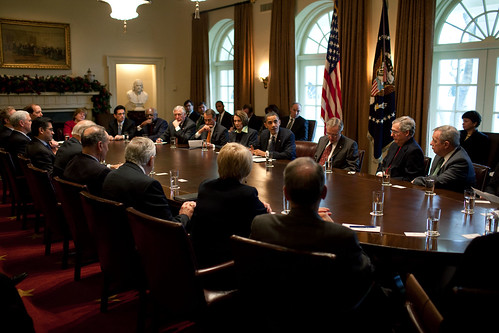
P120909PS-0140, originally uploaded by The White House.
Watching Pete Peterson in an interview with McKinsey shows that our road ahead will be bumpy--not to mention the odds of getting off the road completely. One gathers that tax increases and spending cuts are bound to come, yet the recovery is not in sight. Moreover, the economically conservative theoretic machine has set in motion, with resources from Mr. Peterson as well. The elections in 2010 will most definitely see a dramatic change in Congress unless the employment situation doesn't improve.
In case the player is acting up, here's the transcript.
Pete Peterson—businessman, statesman, philanthropist—has developed an economic
perspective informed by three distinct and first-hand relationships with American policy. In this video interview, the cofounder of Blackstone and former secretary of commerce reflects on his storied career and his recent memoir, The Education of an American Dreamer. He also looks forward—sharing his ideas on deficit reduction, changes in private equity, the fate of the dollar, and how to rebuild the US economy for future generations. Rik Kirkland, McKinsey’s director of publishing, spoke with Mr. Peterson in New York in November 2009.
The Quarterly: We’re here today with Pete Peterson, who is cofounder of the Blackstone Group, former secretary of commerce, and chairman emeritus of the Council on Foreign Relations. Pete, thanks for being with us today.
Peter Peterson: My pleasure.
The Quarterly: Now, in your long and distinguished career as a business executive and a statesman, you’ve also been an author. Your latest book is The Education of an American Dreamer. So why did you write it, and what are some of the things you learned?
Peter Peterson: Well, you know, when you’re a businessman and you’re pompous enough and presumptuous enough to write books, you have to be prepared to be roasted. And my favorite roaster is Ted Sorenson, who, about my last book said, “Once you put it
down, you will not be able to pick it up.” That was not enough to discourage me, but I think this is the last one. This is a memoir.
Why did I write it? Well, I have nine grandchildren and five children. I’m particularly concerned that the American dream that has made me into an American dreamer will no longer be there for them. So I thought it would be worthwhile for those nine grandchildren, and who else wants to read it, to realize that there are opportunities in this country if you work hard enough and make the right decisions.
One of the lessons I’ve learned is to apply the Adam Smith principle in your business career: comparative advantage. Focus on the things that you do better than the other things that you do, and resist the seductions of a little more pay or a little nicer office or a little better title if it does not play to your strengths. Secondly, pick a field where your passions are, because the combination of playing to your strengths and being passionate about it can make a very big difference in a career.
The Quarterly: The book ends with you taking the fortune you earned when Blackstone went public and putting it into a private foundation, the Peterson Foundation. I was wondering if you could talk about that.
Peter Peterson: There are certain long-term challenges that I call “undeniable, unsustainable, and yet politically untouchable.” I thought of myself on my deathbed looking back and saying, “I’ve been very concerned about these challenges,” of which I include entitlements, Social Security, Medicare, our huge balance of payments, deficits, our foreign debts, our lack of savings in this country, and why I think they’re going to impair
our future.
The Quarterly: So what are some of the things the foundation is doing?
Peter Peterson: Well, we’re doing a number of things. We’re focusing pretty heavily on the young, because it’s their future that’s being impaired. And you know the old joke about the philosophy class where the professor says to the class, “Which is worse, ignorance or apathy?” And some sleepy kid from the back says, “I don’t know and I don’t care.”
Well they had better start caring, because on the track we’re on, their taxes are going to increase dramatically. The unfunded liabilities total nearly $60 trillion, falling squarely on them.
I have a dream, which is that we would be smart enough and lucky enough to set up an organization called the American Association of Young People. We have the American Association of Retired Persons, 39 million strong, who are an enormously effective lobbying group. But I think our kids need a lobby too—they and their parents. So we’re putting a lot of focus on the young.
The Quarterly: This is an issue that you’ve talked about for 20 years very articulately, and it obviously concerns a lot of people in this country. And I mean no disrespect to you, but the fact is, for the whole period you’ve talked about it, the problem hasn’t gone away.
In fact, it’s probably gotten worse. What gives you hope that we will finally begin to deal with it? And how do we deal with it right now at a time when the stimulus bill and the need to get out of this economic slump have made the deficit temporarily bigger?
Peter Peterson: What we’ve got to do is somehow make it safer for the politicians to
do the right thing. And we have to make it unsafe for them to do nothing. So I think a lot of this is the politics of short-termism and the politics of entitlements—one of my least favorite words. We think the time has come for a very special bipartisan commission, composed of equal numbers of Democrats and Republicans.
The Quarterly: It’s along the lines of the Greenspan commission?
Peter Peterson: Yes, with some special wrinkles, in which everything is on the table. And the procedures are a little bit like how we handle military base closings, where we’ve discovered that if you only handle these military bases one at a time, you kind of get cherry picked. What we’re envisioning is a group in which everything is on the table.
You can’t eliminate the need for tax increases. We will need some tax increases. You
cannot avoid the fact that the major part of the burden is going to have to be in spending reductions. We have a political system now in which too many Republicans have never met a tax cut they didn’t like, and too many Democrats have not met an entitlement spending program they don’t adore.
So what has happened? We’ve ended up with both of them. So there’s going to be enormous financing needs. I’m just talking to an expert that I’m working with on this. He’s trying to predict how much the treasury financing is going to have to be. And he said, “I can just tell you, they are skyrocketing and unbelievable.” Well, we’d better start asking the question, “Where’s the money going to come from?” And it’s terribly important, in my opinion, to send a signal to the foreign sources that we’re going to get our fiscal house in order.
The Quarterly: Let me close by asking you about one other area of your expertise, which is the private-equity markets, where Blackstone is a huge player and a very successful player. I’m just wondering if you could sort of both look over the evolution of the industry and look, say, five years out from now. Will it have bounced back to what it was a year or so ago? Will it be different in any fundamental ways?
Peter Peterson: Well, it’s changed enormously since Steve Schwarzman and I started
the firm in 1985. If you stop and think about it, the ’90s were a golden period for any leverage business. If you can get a lot of leverage—and we could get leverage (four to eight times)—and you have low interest rates and you have price earnings ratios doubling as they did during the ’90s, you’d have to be intellectually challenged not to make some money in that kind of an environment. And we got in the habit of believing it was our own financial genius that enabled us to make 30 and 40 percent returns. And it was very importantly a matter of dumb luck—plus whatever abilities we did have.
Now, the recent years have been the opposite. There has not been a lot of money left for leverage. You know, you have to go out and earn it by more productivity and more operational improvements. So the center of gravity of the private-equity business shifted from financial engineering to operational improvements. I have every reason to believe that’s going to continue, because once it starts, those who improve earnings and have confidence in our ability to improve earnings will be able to pay more than the firms that are relying totally on financial engineering.
The Quarterly: There’s been a lot of talk in the last few months about the role of the dollar and the dollar’s role to reserve currency. Do you believe the dollar’s role will be fundamentally different? Will it be about the same? Does it depend?
Peter Peterson: I think the most likely outcome, if we don’t get our act together, will be some kind of crisis in the dollar. And we all know the dollar falls suddenly and steeply. Interest rates rise very dramatically. So we have inflation and recession at the same time.
The Quarterly: So we can do this the hard way or the harder way?
Peter Peterson: The hard way. There are no easy alternatives. We’re long past that point. We’re talking about $60 trillion, in today’s dollars, of unfunded liabilities and promises. Totally unsustainable. And you’re never going to be able to solve this just by increasing taxes. You could get rid of the Bush tax cuts. You could get rid of all earmarks. You could get out of both wars. And it only covers 15 percent of our unfunded liabilities and promises.
The Quarterly: It really is Medicaid, Medicare, and Social Security.
Peter Peterson: Medicare and Medicaid. Medicare is $38 trillion; Social Security is $7 trillion, basically.
The Quarterly: And that’s where all the voters are. So go back to your association of young people, right? That’s what it’s going to take. Pete, thank you for being with us today. You’re still dreaming, and it’s a great story. We appreciate it.
Peter Peterson: Thank you.
__________________________
Now, Pete Peterson may look and sound like the old-wise guy, but doesn't he see any problem with our system/ He should know better, being an insider to many a power circle. A look at his recent book reveals that while he had been CEO of Bell&Howell, an American manufacturing operation, in the '60s, productivity grew under his command, but the sustainability of the business proved to be lacking not long after he left--the Japanese manufacturers saw the future in electronics, the American executive, concentrating on productivity improvements (read, cost cutting, which in today's version spells offshoring) could not see. I'm sure the reader of this blog is smarter than Mr. Peterson lets us in...
Pete Peterson—businessman, statesman, philanthropist—has developed an economic
perspective informed by three distinct and first-hand relationships with American policy. In this video interview, the cofounder of Blackstone and former secretary of commerce reflects on his storied career and his recent memoir, The Education of an American Dreamer. He also looks forward—sharing his ideas on deficit reduction, changes in private equity, the fate of the dollar, and how to rebuild the US economy for future generations. Rik Kirkland, McKinsey’s director of publishing, spoke with Mr. Peterson in New York in November 2009.
The Quarterly: We’re here today with Pete Peterson, who is cofounder of the Blackstone Group, former secretary of commerce, and chairman emeritus of the Council on Foreign Relations. Pete, thanks for being with us today.
Peter Peterson: My pleasure.
The Quarterly: Now, in your long and distinguished career as a business executive and a statesman, you’ve also been an author. Your latest book is The Education of an American Dreamer. So why did you write it, and what are some of the things you learned?
Peter Peterson: Well, you know, when you’re a businessman and you’re pompous enough and presumptuous enough to write books, you have to be prepared to be roasted. And my favorite roaster is Ted Sorenson, who, about my last book said, “Once you put it
down, you will not be able to pick it up.” That was not enough to discourage me, but I think this is the last one. This is a memoir.
Why did I write it? Well, I have nine grandchildren and five children. I’m particularly concerned that the American dream that has made me into an American dreamer will no longer be there for them. So I thought it would be worthwhile for those nine grandchildren, and who else wants to read it, to realize that there are opportunities in this country if you work hard enough and make the right decisions.
One of the lessons I’ve learned is to apply the Adam Smith principle in your business career: comparative advantage. Focus on the things that you do better than the other things that you do, and resist the seductions of a little more pay or a little nicer office or a little better title if it does not play to your strengths. Secondly, pick a field where your passions are, because the combination of playing to your strengths and being passionate about it can make a very big difference in a career.
The Quarterly: The book ends with you taking the fortune you earned when Blackstone went public and putting it into a private foundation, the Peterson Foundation. I was wondering if you could talk about that.
Peter Peterson: There are certain long-term challenges that I call “undeniable, unsustainable, and yet politically untouchable.” I thought of myself on my deathbed looking back and saying, “I’ve been very concerned about these challenges,” of which I include entitlements, Social Security, Medicare, our huge balance of payments, deficits, our foreign debts, our lack of savings in this country, and why I think they’re going to impair
our future.
The Quarterly: So what are some of the things the foundation is doing?
Peter Peterson: Well, we’re doing a number of things. We’re focusing pretty heavily on the young, because it’s their future that’s being impaired. And you know the old joke about the philosophy class where the professor says to the class, “Which is worse, ignorance or apathy?” And some sleepy kid from the back says, “I don’t know and I don’t care.”
Well they had better start caring, because on the track we’re on, their taxes are going to increase dramatically. The unfunded liabilities total nearly $60 trillion, falling squarely on them.
I have a dream, which is that we would be smart enough and lucky enough to set up an organization called the American Association of Young People. We have the American Association of Retired Persons, 39 million strong, who are an enormously effective lobbying group. But I think our kids need a lobby too—they and their parents. So we’re putting a lot of focus on the young.
The Quarterly: This is an issue that you’ve talked about for 20 years very articulately, and it obviously concerns a lot of people in this country. And I mean no disrespect to you, but the fact is, for the whole period you’ve talked about it, the problem hasn’t gone away.
In fact, it’s probably gotten worse. What gives you hope that we will finally begin to deal with it? And how do we deal with it right now at a time when the stimulus bill and the need to get out of this economic slump have made the deficit temporarily bigger?
Peter Peterson: What we’ve got to do is somehow make it safer for the politicians to
do the right thing. And we have to make it unsafe for them to do nothing. So I think a lot of this is the politics of short-termism and the politics of entitlements—one of my least favorite words. We think the time has come for a very special bipartisan commission, composed of equal numbers of Democrats and Republicans.
The Quarterly: It’s along the lines of the Greenspan commission?
Peter Peterson: Yes, with some special wrinkles, in which everything is on the table. And the procedures are a little bit like how we handle military base closings, where we’ve discovered that if you only handle these military bases one at a time, you kind of get cherry picked. What we’re envisioning is a group in which everything is on the table.
You can’t eliminate the need for tax increases. We will need some tax increases. You
cannot avoid the fact that the major part of the burden is going to have to be in spending reductions. We have a political system now in which too many Republicans have never met a tax cut they didn’t like, and too many Democrats have not met an entitlement spending program they don’t adore.
So what has happened? We’ve ended up with both of them. So there’s going to be enormous financing needs. I’m just talking to an expert that I’m working with on this. He’s trying to predict how much the treasury financing is going to have to be. And he said, “I can just tell you, they are skyrocketing and unbelievable.” Well, we’d better start asking the question, “Where’s the money going to come from?” And it’s terribly important, in my opinion, to send a signal to the foreign sources that we’re going to get our fiscal house in order.
The Quarterly: Let me close by asking you about one other area of your expertise, which is the private-equity markets, where Blackstone is a huge player and a very successful player. I’m just wondering if you could sort of both look over the evolution of the industry and look, say, five years out from now. Will it have bounced back to what it was a year or so ago? Will it be different in any fundamental ways?
Peter Peterson: Well, it’s changed enormously since Steve Schwarzman and I started
the firm in 1985. If you stop and think about it, the ’90s were a golden period for any leverage business. If you can get a lot of leverage—and we could get leverage (four to eight times)—and you have low interest rates and you have price earnings ratios doubling as they did during the ’90s, you’d have to be intellectually challenged not to make some money in that kind of an environment. And we got in the habit of believing it was our own financial genius that enabled us to make 30 and 40 percent returns. And it was very importantly a matter of dumb luck—plus whatever abilities we did have.
Now, the recent years have been the opposite. There has not been a lot of money left for leverage. You know, you have to go out and earn it by more productivity and more operational improvements. So the center of gravity of the private-equity business shifted from financial engineering to operational improvements. I have every reason to believe that’s going to continue, because once it starts, those who improve earnings and have confidence in our ability to improve earnings will be able to pay more than the firms that are relying totally on financial engineering.
The Quarterly: There’s been a lot of talk in the last few months about the role of the dollar and the dollar’s role to reserve currency. Do you believe the dollar’s role will be fundamentally different? Will it be about the same? Does it depend?
Peter Peterson: I think the most likely outcome, if we don’t get our act together, will be some kind of crisis in the dollar. And we all know the dollar falls suddenly and steeply. Interest rates rise very dramatically. So we have inflation and recession at the same time.
The Quarterly: So we can do this the hard way or the harder way?
Peter Peterson: The hard way. There are no easy alternatives. We’re long past that point. We’re talking about $60 trillion, in today’s dollars, of unfunded liabilities and promises. Totally unsustainable. And you’re never going to be able to solve this just by increasing taxes. You could get rid of the Bush tax cuts. You could get rid of all earmarks. You could get out of both wars. And it only covers 15 percent of our unfunded liabilities and promises.
The Quarterly: It really is Medicaid, Medicare, and Social Security.
Peter Peterson: Medicare and Medicaid. Medicare is $38 trillion; Social Security is $7 trillion, basically.
The Quarterly: And that’s where all the voters are. So go back to your association of young people, right? That’s what it’s going to take. Pete, thank you for being with us today. You’re still dreaming, and it’s a great story. We appreciate it.
Peter Peterson: Thank you.
__________________________
Now, Pete Peterson may look and sound like the old-wise guy, but doesn't he see any problem with our system/ He should know better, being an insider to many a power circle. A look at his recent book reveals that while he had been CEO of Bell&Howell, an American manufacturing operation, in the '60s, productivity grew under his command, but the sustainability of the business proved to be lacking not long after he left--the Japanese manufacturers saw the future in electronics, the American executive, concentrating on productivity improvements (read, cost cutting, which in today's version spells offshoring) could not see. I'm sure the reader of this blog is smarter than Mr. Peterson lets us in...
It still can go anywhere
As Secretaries Clinton and Geithner went to China, I wondered if and how long before we had a roadmap for the reunification of Taiwan. Such roadmap would be a prerequisite of Chimerica.
However, some important voices consider the notion of a duopoly between China and America (Chimerica) a mirage and suggest that a way out would be for the US and other countries to speak to China with one voice. Moreover, from Der Spiegel, we learn that:
One can only ask, where is multilateralism when you need it? Bush, the president about whom the Economist wrote that there had been no multilateral agreement to his liking, and his neocon apparatus have a lot to answer for this. The most that camp could come up with was the group of democracies, through the writings of Robert Kagan, during John McCain's electoral campaign.
The challenge now is for Obama to convince the US allies, and the world at large, that there is in the self interest of everyone to continue to support Pax Americana, and the US dollar. In other words, it's worth paying protection tax, as it were. However, the challenge then becomes how to frame LARGE the loses of leaving the US shrinking umbrella when countries and peoples suffer what they may soon imagine as a deluge.
And, for whatever reason, I now feel compelled to make the following observation: There is no tax cut, or at least not as it's been defined by the conservative camp. It's only a taxation position along a continuum defined between front-loading and back-loading.
However, some important voices consider the notion of a duopoly between China and America (Chimerica) a mirage and suggest that a way out would be for the US and other countries to speak to China with one voice. Moreover, from Der Spiegel, we learn that:
Last month, Beijing completed the last of a series of so-called currency swaps -- providing yuan to other central banks for use in trade with China -- with Argentina, Hong Kong, Indonesia, Malaysia, South Korea, and others. These arrangements theoretically removed any need for these trading partners to use the dollar as an intermediary currency in dealing with China. Last week, Beijing denominated a bilateral trade deal with Brazil in the two countries' currencies, rather than in dollars; the value of the agreement was not specified. The value of the other agreements comes to $95 billion (€68 billion). By way of comparison, US-Chinese trade amounted to $333 billion (€238 billion) in 2008.So China is using bilateralism, not unlike the US has since the end of the Cold War, to grow its status. Moreover, China is coopting US friends as well into her bilateralism.
One can only ask, where is multilateralism when you need it? Bush, the president about whom the Economist wrote that there had been no multilateral agreement to his liking, and his neocon apparatus have a lot to answer for this. The most that camp could come up with was the group of democracies, through the writings of Robert Kagan, during John McCain's electoral campaign.
The challenge now is for Obama to convince the US allies, and the world at large, that there is in the self interest of everyone to continue to support Pax Americana, and the US dollar. In other words, it's worth paying protection tax, as it were. However, the challenge then becomes how to frame LARGE the loses of leaving the US shrinking umbrella when countries and peoples suffer what they may soon imagine as a deluge.
And, for whatever reason, I now feel compelled to make the following observation: There is no tax cut, or at least not as it's been defined by the conservative camp. It's only a taxation position along a continuum defined between front-loading and back-loading.
A step closer to the core of one of our most common problems
Trading Away Productivity
By ALAN TONELSON and KEVIN L. KEARNS
FOR a quarter-century, American economic policy has assumed that the keys to durable national prosperity are deregulation, free trade and a swift transition to a post-industrial, services-dominated future.
Such policies, advocates say, drive innovation, which leads to enormous labor productivity and wage gains — more than enough, supposedly, to make up for the labor disruptions that accompany free trade and de-industrialization.
[N.B. In fact, labor productivity has been an eternal obsession of the US capitalist, shared at one point by the now-defunct comrades in the planned economies. Have a look at The Politicos vs An old man]
In reality, though, wage gains for the average worker have lagged behind productivity since the early 1980s, a situation that free-traders usually attribute to workers failing to retrain themselves after seeing their jobs outsourced.
[N.B. So what does it mean if this were indeed a failure of the workers? Too bad they could not retrain themselves to become neurosurgeons or derivative traders?]
But what if wages lag because productivity itself is being grossly overstated, especially in the nation’s manufacturing sector? Then, suddenly, a cornerstone of American economic policy would begin to crumble.
Productivity measures how many worker hours are needed for a given unit of output during a given time period; when hours fall relative to output, labor productivity increases. In 2009, the data show, Americans needed 40 percent fewer hours to produce the same unit of output as in 1980.
But there’s a problem: labor productivity figures, which are calculated by the Labor Department, count only worker hours in America, even though American-owned factories and labs have been steadily transplanted overseas, and foreign workers have contributed significantly to the final products counted in productivity measures.
The result is an apparent drop in the number of worker hours required to produce goods — and thus increased productivity. But actually, the total number of worker hours does not necessarily change.
This oversight is no secret: as Labor Department officials acknowledged at a 2004 conference, their statistical methods deem any reduction in the work that goes into creating a specific unit of output, whatever the cause, to be a productivity gain.
This continuing mismeasurement leads economists and all those who rely on them to assume that recorded productivity gains always signify greater efficiency, rather than simple offshoring-generated cost cuts — leaving the rest of us scratching our heads over stagnating wages.
[N.B. Why would few push this, where was the organized labor?]
Of course, just because productivity is mismeasured doesn’t mean that genuine innovations can’t improve living standards. It does mean, however, that Americans are flying blind when it comes to their economy’s strengths and weaknesses, and consequently drawing the wrong policy lessons.
Above all, if offshoring has been driving much of our supposed productivity gains, then the case for complete free trade begins to erode. If often such policies simply increase corporate profits at the expense of American workers, with no gains in true productivity, then they don’t necessarily strengthen the national economy.
[N.B. This seems a clear case when regulation should help protect capitalism from capitalists.]
In this regard, the case for free trade as a stimulus for innovation weakens, too. Because productivity gains in part reflect job offshoring, not just the benefits of technology or better business practices, then the American economy has been much less innovative than widely assumed.
How can we actually increase innovation and real productivity? Manufacturing, long slighted by free-market extremists, needs to be promoted, not pushed offshore, since it has historically accounted for the bulk of research and development spending and employs the bulk of American science and technology workers — who in turn spur further innovation and real productivity.
Promoting manufacturing will require major changes in tax and trade policies that currently foster offshoring, including implementing provisions to punish currency manipulation by countries like China and help American producers harmed by discriminatory foreign value-added tax systems. It also means revitalizing government and corporate research and development, which has languished since its heyday in the 1960s.
Much of government policy and business strategy rides on false assumptions about innovation, and although the Obama administration acknowledges the problem, it has done nothing to correct it. With the economy still in need of government life support and the future of American manufacturing in doubt, relying on faulty productivity data is a formula for disaster.
Alan Tonelson, a fellow at the United States Business and Industry Council, is the author of “The Race to the Bottom.” Kevin L. Kearns is the president of the council, which is an association of small manufacturers.
By ALAN TONELSON and KEVIN L. KEARNS
FOR a quarter-century, American economic policy has assumed that the keys to durable national prosperity are deregulation, free trade and a swift transition to a post-industrial, services-dominated future.
Such policies, advocates say, drive innovation, which leads to enormous labor productivity and wage gains — more than enough, supposedly, to make up for the labor disruptions that accompany free trade and de-industrialization.
[N.B. In fact, labor productivity has been an eternal obsession of the US capitalist, shared at one point by the now-defunct comrades in the planned economies. Have a look at The Politicos vs An old man]
In reality, though, wage gains for the average worker have lagged behind productivity since the early 1980s, a situation that free-traders usually attribute to workers failing to retrain themselves after seeing their jobs outsourced.
[N.B. So what does it mean if this were indeed a failure of the workers? Too bad they could not retrain themselves to become neurosurgeons or derivative traders?]
But what if wages lag because productivity itself is being grossly overstated, especially in the nation’s manufacturing sector? Then, suddenly, a cornerstone of American economic policy would begin to crumble.
Productivity measures how many worker hours are needed for a given unit of output during a given time period; when hours fall relative to output, labor productivity increases. In 2009, the data show, Americans needed 40 percent fewer hours to produce the same unit of output as in 1980.
But there’s a problem: labor productivity figures, which are calculated by the Labor Department, count only worker hours in America, even though American-owned factories and labs have been steadily transplanted overseas, and foreign workers have contributed significantly to the final products counted in productivity measures.
The result is an apparent drop in the number of worker hours required to produce goods — and thus increased productivity. But actually, the total number of worker hours does not necessarily change.
This oversight is no secret: as Labor Department officials acknowledged at a 2004 conference, their statistical methods deem any reduction in the work that goes into creating a specific unit of output, whatever the cause, to be a productivity gain.
This continuing mismeasurement leads economists and all those who rely on them to assume that recorded productivity gains always signify greater efficiency, rather than simple offshoring-generated cost cuts — leaving the rest of us scratching our heads over stagnating wages.
[N.B. Why would few push this, where was the organized labor?]
Of course, just because productivity is mismeasured doesn’t mean that genuine innovations can’t improve living standards. It does mean, however, that Americans are flying blind when it comes to their economy’s strengths and weaknesses, and consequently drawing the wrong policy lessons.
Above all, if offshoring has been driving much of our supposed productivity gains, then the case for complete free trade begins to erode. If often such policies simply increase corporate profits at the expense of American workers, with no gains in true productivity, then they don’t necessarily strengthen the national economy.
[N.B. This seems a clear case when regulation should help protect capitalism from capitalists.]
In this regard, the case for free trade as a stimulus for innovation weakens, too. Because productivity gains in part reflect job offshoring, not just the benefits of technology or better business practices, then the American economy has been much less innovative than widely assumed.
How can we actually increase innovation and real productivity? Manufacturing, long slighted by free-market extremists, needs to be promoted, not pushed offshore, since it has historically accounted for the bulk of research and development spending and employs the bulk of American science and technology workers — who in turn spur further innovation and real productivity.
Promoting manufacturing will require major changes in tax and trade policies that currently foster offshoring, including implementing provisions to punish currency manipulation by countries like China and help American producers harmed by discriminatory foreign value-added tax systems. It also means revitalizing government and corporate research and development, which has languished since its heyday in the 1960s.
Much of government policy and business strategy rides on false assumptions about innovation, and although the Obama administration acknowledges the problem, it has done nothing to correct it. With the economy still in need of government life support and the future of American manufacturing in doubt, relying on faulty productivity data is a formula for disaster.
Alan Tonelson, a fellow at the United States Business and Industry Council, is the author of “The Race to the Bottom.” Kevin L. Kearns is the president of the council, which is an association of small manufacturers.
Northern Europe Rules // The Price of Power
From the recently released 2005 Global Competitiveness Report, by the World Economic Forum (WEF), we learn the Finland tops the charts for the second consecutive year. The presence of several North-European countries in top ten disproves the thesis that high national tax rates obstruct countries from competing effectively in world markets, or from delivering to their respective populations some of the highest standards of living in the world. The Report is "suggesting that what is important is how well the government revenues are spent, rather than the tax burden per se."
The US continues to hold technological supremacy, and maintain the premiere pipeline of innovation in the world. The US companies are aggressive in adopting new technologies, and spend heavily on R&D. However, the US leadership in these areas is being moderated by its lower performance in other areas measured by the WEF composite index. Macroeconomic imbalances in the country, especially in the area of the public finances, keep the US on the second place. So, despite "overall technological supremacy" the US is downgraded by poor economic management and the perceived negative influence of business lobbies on government policy.
Global Competitive Index
|
| GCI | GCI | |
| Country | 2005 Rank | 2004 Rank | Changes 2004-2005 |
| Finland | 1 | 1 | 0 |
| United States | 2 | 2 | 0 |
| Sweden | 3 | 3 | 0 |
| Denmark | 4 | 5 | 1 |
| Taiwan | 5 | 4 | -1 |
| Singapore | 6 | 7 | 1 |
| Iceland | 7 | 10 | 3 |
| Switzerland | 8 | 8 | 0 |
| Norway | 9 | 6 | -3 |
| Australia | 10 | 14 | 4 |
Source: http://www.weforum.org/
What do you see outside?
 |
| Francis Bacon, Study for Bullfight No 2 (1969) I think that man now realizes that he is an accident, that he is a completely futile being, that he has to play the game without reason. [...] You see, all art has now become completely a game by which man distracts himself (Bacon-Sylvester, Interviews, pp. 28,29). |
I have signaled the descent of our western system, based on economic liberalism and democracy projected to global proportions, since before its 2008 Crisis. After three years, during which governments have saved the capitalists by imposing austerity on the populace, we are semi-officially in a 'Small Depression' according to Paul Krugman. The ordering belief must be that in a world distracted from facts, the capitalists are the only ones to be trusted to {harness, muster, unleash, ...} {creativity, innovation, renewal, growth...}; indeed, capitalists are always selected according to their being best able to align self-interest with action, the best indicator of a well-running capitalist engine, that is. Stimulating the economy by placing money in the hands of the populace, yours and mine, mostly increases the trade deficit--I have written this too. Problem is that capitalists are known to buy imports too, unless they park the money in some unproductive niche.
So, what's a government to do anymore? A cynical may say that those populating governments are merely interested in preserving class privileges while subsidizing a nice show. While that is true, can you think of a way out?
For example, the French and Italians citizens thought that by electing economically-liberal demagogues, growth would be assured. I am skeptical Berlusconi or Sarkozy fulfilled any of their electoral promises. I am equally skeptical of Cameron's prospects in the UK.
Could it be that we need to take a half-step back from globalization? Taxing the incentive out of the financial speculation can certainly help. This addresses in part the flexibility of capital, and the question becomes, how flexible ought capital to be? For example, Simon Johnson, MIT professor and former Chief Economist of IMF, is not the only to suggest a tax on “excess leverage;" Tobin taxes are also quick to come to mind. Then, shouldn't we reconsider the French idea for a reduced work load for all, thus being able to employ more? Yes, we must also get adjusted to the idea that floating is better than sinking, while not as fun as swimming. In the end, I don't care much about the extent to which these ideas are in agreement with one's standard of free-market capitalism, for I remind you, what we've had so far hasn't been free-market capitalism either. Don't you also find it problematic that each time one tries to argue for active management of the situation, the capitalist (ventriloquist) counters that due to the complexity of the system, the self-adjustment capability of the markets, free of regulation and taxes, is better than any one's fallible mind?
In any case, the above ideas are neither of the left, nor of the right. They are about the art of living and reflecting upon it not long thereafter.
+
It's most regrettable what happened in Oslo. I have a feeling that just blaming Anders Behring Breivik is not going to deter forever another symptom of our common disease. Breivik seems to have been against multiculturalism, whatever that meant in his case beyond being anti-Muslim immigration as a new form of Marxist internationalism--I know, it's a mouthful and I could use some European help to unpack it.Shock and/or incomprehension, ensuing the massive destruction inflicted by World War I on so many, was not enough to prevent fascism or Nazism from coalescing as reaction to the dissolution of the world order, perceived then by the former as the result of the centrifugal forces of communism and/or international finance.
As wise people have always said, and the demagogues exploited to i/a-mmoral ends, humans need to believe in something greater than, say, self-interest. That something had better be based on moral law. Replacing sacred religion with the secular religion of self-interest, briefly introduced as part of a moral code based on natural law by Adam Smith, has not worked too well. As for how religion is observed in the US, let me just say, per out tax code and all that, it's big business for a minority and of whatever comfort for most--read this last statement in terms of effectiveness.
Through my Window(s), I see Tauoromachia.
What do these youth know and the world hasn't figured out yet?
Do the police know whom they are con/fronting, as in interfacing?
Is democracy the legitimate monopoly of power? What makes it no longer so?
When humanism is lost, do we regress to homo homini lupus? How do we come back?
What do these youth know and the world hasn't figured out yet?
Do the police know whom they are con/fronting, as in interfacing?
Is democracy the legitimate monopoly of power? What makes it no longer so?
When humanism is lost, do we regress to homo homini lupus? How do we come back?
Bubble tea, tea or Coca-Cola?
This past winter, during a half-day stopover in Paris, I took to its streets, wandering more or less aimlessly. Near the Archives nationales I went into a boutique de thé, tea shop, where I must have spent more than a half-hour going through three large rooms whose walls were lined up with teas of all kinds. I concluded with one of the three sales ladies that we must have entered the Asian century since we were talking theine in France, a place associated rather with tannin.

The post-WWII era is coming to an end. Its most taken for granted institutions, (e.g., the US dollar, NATO, IMF, etc.) and ideologies (globalization, neo-liberalism, etc.) have come under stress, and I take the advent of tea as another sign of the growing Chinese/Asian influence. Such signs can give us an idea-set about one of the directions the world may go into. Our own history, in the western market democracies, that is, gives the complementary directions.
It is not easy to foretell if, let alone how, the world turns Asian. If the capitalist model of growth, based on credit, fiat money and inflation, proves to be irresistible, the Chinese still need to put a lot of work into building up a worldwide financial system, with rules and institutions. This kind of work takes decades and/or catastrophic event(s) to bear fruit. The attractiveness of the Chinese economy in a capitalist scenario consists of its being able to theoretically contain larger bubbles than the rest of world. In fact, the world seems headed into a hyper-capitalist direction where countries assemble in blocs and the individual economic entities grow even more. On its current iteration, the EUro bloc stumbled by being just as resilient as its most exposed economy. If the EUro picks up steam again, the US will have to count its friends and integrate accordingly.
From the western history lessons , one should be reminded, if not told, that market democracies had gone through at least one crisis, similar to the one started in 2008, in the beginning of the 20th century, when the international and national versions of socialism looked like better alternatives to the capitalism that worked for fewer and fewer at the expense of most. Communism and Nazism, those being the two versions of socialism introduced above, had their constituencies even in Britain, still the bastion of capitalism at the time--in fact, there were even top royal British figures flirting with Nazism, while Churchill, the ever ideologically-swinging opportunist, found a vocation in opposing Nazism.
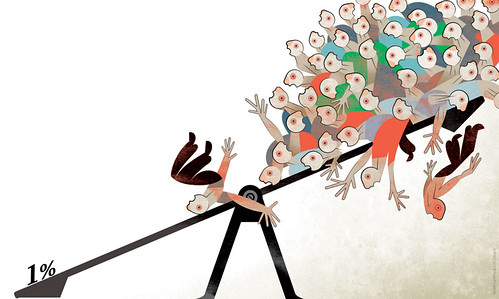
In an economical system predicated on limitless growth, problems on the home front start brewing when the system relegates the willing and educated to un/under-employment. Lack of labor competitiveness can work as justification for only so long before these educated folks give ideological shape to the general dissatisfaction with neo-liberal globalization (e.g., trade liberalization, exchange rate controls, and tax-free flow of money). The western elites (aka 1%) are fully aware of all this, and the never-ending war on terror is just a cover for how far the elites have been willing to go to defend the status qvo ante 2008. Another means to counter the emergence of an opposition to neo-liberal globalization is to quickly consider any alternative as enemy of civilization--you know the usual suspects, extremism, nationalism, socialism, totalitarianism, isolationism, etc.
Also, the S-Ir(i)anian diversions can only take us on collision (or is it collusion?) course with China and Russia. While the Russians have been neatly folded in the world system, and the Chinese have risen within the world system, they show signs of nervousness about their positions relative to the hegemon. Strictly on military terms, the US is still ahead, but otherwise, the defection of Germany and/or Japan to side with the challengers can signal continental shifts. Collision is therefore likely to take place through proxies, whereas collusion would give the challengers first right of refusal over certain places on Earth. Of course, the challengers ought to also face their own internal problems--the Russians have to learn how to live with lowering commodity prices, whereas the Chinese are not anywhere close to having developed a viable growth model/alternative at national scale, let alone planetary scale--but then again, who's gonna call their bluff? The existing credit rating agencies and/or Basel III type of capital requirements... or rather plenty of regional conflicts to the effect of Brzezinskian creative volatility.
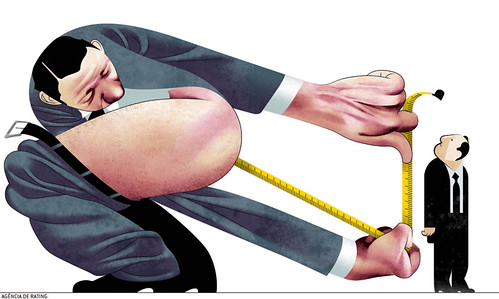
To return to the US, the bromides of eventually operating markets, be those economic or political, are wearing thin. In fact, markets are social constructs that need constant oversight under the guidance of whatever socially accepted principles. There is nothing intrinsic to markets that prevents the capitalist excess on its way up or down; markets make only a nice abstraction behind which the few tax the most with impunity. Meanwhile, the US academics, busying as usual with minute correlations, are still to catch up with the enormity of the task. One of the difficulties is the epistemological bias against systemic, or ecological, treatment of the problem. Time for change in the ivory towers will come as the higher-ed bubble may lose some air given the job market difficulties of the ever more indebted graduates. However, Americans overall are catching up--a search by "crisis economics" on Amazon.com yields 57,557 results as of this writing.
So, what seems sensible to do? The Occupy movements and the libertarians are just too conceptually fragile to make any progress, given how time changes things. A locally verified solution of the capitalist excess would be something akin to the New Deal. Rather than plunge ourselves down the spiral of destitution and despair for not having a Steve Jobs among each fifty-thousand of us, we could stop thinking in terms of labor competitiveness on a global scale for as long as the jobs match the skills and the fruits of labor enable the best of us to take the whole economy to the next level up. Turning a blind eye to the under-educated immigrants can only depress incomes of the locals, preventing most American children from becoming the next Steve Jobs. Also, good healthcare and education ought to be human rights, not a matter of personal income.
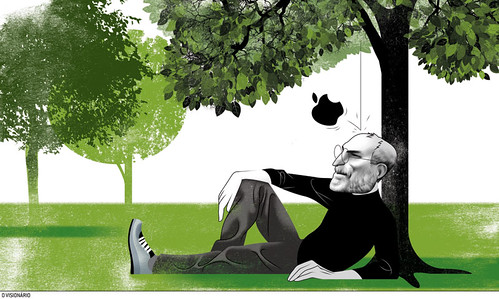
Another new deal requires that the American elite adopt a historically informed perspective, which the current generation of leaders is found missing. There are also notable exceptions, such as Felix Rohatyn, of course, of a different generation, whose 2009 book offers a blueprint that's workable within the current system.
In closing, before we decide on the type of beverage for the next course, I include an extended reference from Minqi Li, a scholar (Chinese-American?) whose pivotal perspective complements, if not supplants, many in sketching the politico-economical landscape ahead.
Please note that Minqi Li indicates that the planet may not sustain a bubble tea, regardless of the capitalist logic of the global investor.
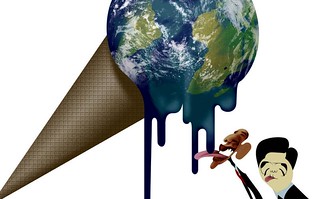
The post-WWII era is coming to an end. Its most taken for granted institutions, (e.g., the US dollar, NATO, IMF, etc.) and ideologies (globalization, neo-liberalism, etc.) have come under stress, and I take the advent of tea as another sign of the growing Chinese/Asian influence. Such signs can give us an idea-set about one of the directions the world may go into. Our own history, in the western market democracies, that is, gives the complementary directions.
It is not easy to foretell if, let alone how, the world turns Asian. If the capitalist model of growth, based on credit, fiat money and inflation, proves to be irresistible, the Chinese still need to put a lot of work into building up a worldwide financial system, with rules and institutions. This kind of work takes decades and/or catastrophic event(s) to bear fruit. The attractiveness of the Chinese economy in a capitalist scenario consists of its being able to theoretically contain larger bubbles than the rest of world. In fact, the world seems headed into a hyper-capitalist direction where countries assemble in blocs and the individual economic entities grow even more. On its current iteration, the EUro bloc stumbled by being just as resilient as its most exposed economy. If the EUro picks up steam again, the US will have to count its friends and integrate accordingly.
From the western history lessons , one should be reminded, if not told, that market democracies had gone through at least one crisis, similar to the one started in 2008, in the beginning of the 20th century, when the international and national versions of socialism looked like better alternatives to the capitalism that worked for fewer and fewer at the expense of most. Communism and Nazism, those being the two versions of socialism introduced above, had their constituencies even in Britain, still the bastion of capitalism at the time--in fact, there were even top royal British figures flirting with Nazism, while Churchill, the ever ideologically-swinging opportunist, found a vocation in opposing Nazism.
In an economical system predicated on limitless growth, problems on the home front start brewing when the system relegates the willing and educated to un/under-employment. Lack of labor competitiveness can work as justification for only so long before these educated folks give ideological shape to the general dissatisfaction with neo-liberal globalization (e.g., trade liberalization, exchange rate controls, and tax-free flow of money). The western elites (aka 1%) are fully aware of all this, and the never-ending war on terror is just a cover for how far the elites have been willing to go to defend the status qvo ante 2008. Another means to counter the emergence of an opposition to neo-liberal globalization is to quickly consider any alternative as enemy of civilization--you know the usual suspects, extremism, nationalism, socialism, totalitarianism, isolationism, etc.
Also, the S-Ir(i)anian diversions can only take us on collision (or is it collusion?) course with China and Russia. While the Russians have been neatly folded in the world system, and the Chinese have risen within the world system, they show signs of nervousness about their positions relative to the hegemon. Strictly on military terms, the US is still ahead, but otherwise, the defection of Germany and/or Japan to side with the challengers can signal continental shifts. Collision is therefore likely to take place through proxies, whereas collusion would give the challengers first right of refusal over certain places on Earth. Of course, the challengers ought to also face their own internal problems--the Russians have to learn how to live with lowering commodity prices, whereas the Chinese are not anywhere close to having developed a viable growth model/alternative at national scale, let alone planetary scale--but then again, who's gonna call their bluff? The existing credit rating agencies and/or Basel III type of capital requirements... or rather plenty of regional conflicts to the effect of Brzezinskian creative volatility.
To return to the US, the bromides of eventually operating markets, be those economic or political, are wearing thin. In fact, markets are social constructs that need constant oversight under the guidance of whatever socially accepted principles. There is nothing intrinsic to markets that prevents the capitalist excess on its way up or down; markets make only a nice abstraction behind which the few tax the most with impunity. Meanwhile, the US academics, busying as usual with minute correlations, are still to catch up with the enormity of the task. One of the difficulties is the epistemological bias against systemic, or ecological, treatment of the problem. Time for change in the ivory towers will come as the higher-ed bubble may lose some air given the job market difficulties of the ever more indebted graduates. However, Americans overall are catching up--a search by "crisis economics" on Amazon.com yields 57,557 results as of this writing.
So, what seems sensible to do? The Occupy movements and the libertarians are just too conceptually fragile to make any progress, given how time changes things. A locally verified solution of the capitalist excess would be something akin to the New Deal. Rather than plunge ourselves down the spiral of destitution and despair for not having a Steve Jobs among each fifty-thousand of us, we could stop thinking in terms of labor competitiveness on a global scale for as long as the jobs match the skills and the fruits of labor enable the best of us to take the whole economy to the next level up. Turning a blind eye to the under-educated immigrants can only depress incomes of the locals, preventing most American children from becoming the next Steve Jobs. Also, good healthcare and education ought to be human rights, not a matter of personal income.
Another new deal requires that the American elite adopt a historically informed perspective, which the current generation of leaders is found missing. There are also notable exceptions, such as Felix Rohatyn, of course, of a different generation, whose 2009 book offers a blueprint that's workable within the current system.
| MINQI LI pdf |
Please note that Minqi Li indicates that the planet may not sustain a bubble tea, regardless of the capitalist logic of the global investor.
An apple from the G(B)S Cart*
GREG SMITH has recently come out with the his reasons for leaving Goldman Sachs. Following is his open letter.
TODAY is my last day at Goldman Sachs. After almost 12 years at the firm — first as a summer intern while at Stanford, then in New York for 10 years, and now in London — I believe I have worked here long enough to understand the trajectory of its culture, its people and its identity. And I can honestly say that the environment now is as toxic and destructive as I have ever seen it.
To put the problem in the simplest terms, the interests of the client continue to be sidelined in the way the firm operates and thinks about making money. Goldman Sachs is one of the world’s largest and most important investment banks and it is too integral to global finance to continue to act this way. The firm has veered so far from the place I joined right out of college that I can no longer in good conscience say that I identify with what it stands for.
It might sound surprising to a skeptical public, but culture was always a vital part of Goldman Sachs’s success. It revolved around teamwork, integrity, a spirit of humility, and always doing right by our clients. The culture was the secret sauce that made this place great and allowed us to earn our clients’ trust for 143 years. It wasn’t just about making money; this alone will not sustain a firm for so long. It had something to do with pride and belief in the organization. I am sad to say that I look around today and see virtually no trace of the culture that made me love working for this firm for many years. I no longer have the pride, or the belief.
But this was not always the case. For more than a decade I recruited and mentored candidates through our grueling interview process. I was selected as one of 10 people (out of a firm of more than 30,000) to appear on our recruiting video, which is played on every college campus we visit around the world. In 2006 I managed the summer intern program in sales and trading in New York for the 80 college students who made the cut, out of the thousands who applied.
I knew it was time to leave when I realized I could no longer look students in the eye and tell them what a great place this was to work.
When the history books are written about Goldman Sachs, they may reflect that the current chief executive officer, Lloyd C. Blankfein, and the president, Gary D. Cohn, lost hold of the firm’s culture on their watch. I truly believe that this decline in the firm’s moral fiber represents the single most serious threat to its long-run survival.
Over the course of my career I have had the privilege of advising two of the largest hedge funds on the planet, five of the largest asset managers in the United States, and three of the most prominent sovereign wealth funds in the Middle East and Asia. My clients have a total asset base of more than a trillion dollars. I have always taken a lot of pride in advising my clients to do what I believe is right for them, even if it means less money for the firm. This view is becoming increasingly unpopular at Goldman Sachs. Another sign that it was time to leave.
How did we get here? The firm changed the way it thought about leadership. Leadership used to be about ideas, setting an example and doing the right thing. Today, if you make enough money for the firm (and are not currently an ax murderer) you will be promoted into a position of influence.
What are three quick ways to become a leader? a) Execute on the firm’s “axes,” which is Goldman-speak for persuading your clients to invest in the stocks or other products that we are trying to get rid of because they are not seen as having a lot of potential profit. b) “Hunt Elephants.” In English: get your clients — some of whom are sophisticated, and some of whom aren’t — to trade whatever will bring the biggest profit to Goldman. Call me old-fashioned, but I don’t like selling my clients a product that is wrong for them. c) Find yourself sitting in a seat where your job is to trade any illiquid, opaque product with a three-letter acronym.
Today, many of these leaders display a Goldman Sachs culture quotient of exactly zero percent. I attend derivatives sales meetings where not one single minute is spent asking questions about how we can help clients. It’s purely about how we can make the most possible money off of them. If you were an alien from Mars and sat in on one of these meetings, you would believe that a client’s success or progress was not part of the thought process at all.
It makes me ill how callously people talk about ripping their clients off. Over the last 12 months I have seen five different managing directors refer to their own clients as “muppets,” sometimes over internal e-mail. Even after the S.E.C., Fabulous Fab, Abacus, God’s work, Carl Levin, Vampire Squids? No humility? I mean, come on. Integrity? It is eroding. I don’t know of any illegal behavior, but will people push the envelope and pitch lucrative and complicated products to clients even if they are not the simplest investments or the ones most directly aligned with the client’s goals? Absolutely. Every day, in fact.
It astounds me how little senior management gets a basic truth: If clients don’t trust you they will eventually stop doing business with you. It doesn’t matter how smart you are.
These days, the most common question I get from junior analysts about derivatives is, “How much money did we make off the client?” It bothers me every time I hear it, because it is a clear reflection of what they are observing from their leaders about the way they should behave. Now project 10 years into the future: You don’t have to be a rocket scientist to figure out that the junior analyst sitting quietly in the corner of the room hearing about “muppets,” “ripping eyeballs out” and “getting paid” doesn’t exactly turn into a model citizen.
When I was a first-year analyst I didn’t know where the bathroom was, or how to tie my shoelaces. I was taught to be concerned with learning the ropes, finding out what a derivative was, understanding finance, getting to know our clients and what motivated them, learning how they defined success and what we could do to help them get there.
My proudest moments in life — getting a full scholarship to go from South Africa to Stanford University, being selected as a Rhodes Scholar national finalist, winning a bronze medal for table tennis at the Maccabiah Games in Israel, known as the Jewish Olympics — have all come through hard work, with no shortcuts. Goldman Sachs today has become too much about shortcuts and not enough about achievement. It just doesn’t feel right to me anymore.
I hope this can be a wake-up call to the board of directors. Make the client the focal point of your business again. Without clients you will not make money. In fact, you will not exist. Weed out the morally bankrupt people, no matter how much money they make for the firm. And get the culture right again, so people want to work here for the right reasons. People who care only about making money will not sustain this firm — or the trust of its clients — for very much longer.
Greg Smith resigned from the position of executive director and head of the Goldman Sachs' United States equity derivatives business in Europe, the Middle East and Africa.
--------------------------8<------------------------
The NYTimes readers said the following:
GT LaBordeBirmingham, AL
Thank you, Greg for speaking out. I have been a Goldman client since 2006, and have been trying to get my money out for several years now, to no avail. My money was placed in proprietary funds that have under-performed other similar investments and were clearly designed to maximize Goldman's profit at my expense. I am not allowed to get money out of these investments, in some cases for up to 8-10 years, without a significant "haircut" (hmmm, I wonder if Goldman partners profit from the haircut??).
In one of these investments (which has lost 35% of its value since 2008), Goldman even refuses to provide basic information, like estimates of income or expenses for tax planning purposes. I literally have to guess the income my K-1 will show when I file my taxes in April, because Goldman won't even give me an estimate (much less quarterly or annual commentary or disclosure by the fund managers). In many years, the fund shows substantial interest income (on which I have to pay taxes), but none of that income is ever distributed to me and the NAV of the fund simultaneously goes down. Where did the income go? When asked, Goldman refuses to provide specifics (even though I am a limited partner of the investment partnership and have a right to this information).
It is amazing how little Goldman cares about its customers. Goldman exists for the sole purpose of enriching its partners.

amcCincinnati
Congratulations, Greg!
I resigned from more than one company where integrity was seriously lacking. In my first position, I was ordered to help clients lie on financial statements and change invoices - the partner actually handed me a bottle of white out! I was ordered to be a part of hiding a pension shortfall that I discovered and was walked out for refusing to go along.
I have paid a price for walking away from these 'great opportunities', but I sleep well at night. You are brave to take a stand for your clients and for your own integrity. I applaud you for walking away and for speaking out.
JimNew York
Congratulations Greg. I hope your coworkers read the NYT. I'm sure they will have a good chuckle and maybe a nanosecond of self-reflection. If the financial catastrophe of the last few years did not affect them, I doubt your farewell letter will. They need tighter regulation and oversight, and less gullible clients. Does anyone really question why the Occupy Wall Street movement started?
dprCalifornia
I believe the change in culture you've seen at Goldman Sachs is just a reflection of the change that has taken place in our national culture over the last few decades. When I was growing up, no one considered a person's wealth to be an absolute measure of his or her worth to society. Now, for a large part of our culture, that has changed; the acquisition of wealth is seen as good, no matter how it is achieved.
Money-grubbing behavior is rewarded, and victims of such behavior are considered fair game, not just at Goldman Sachs, but everywhere. My cable company charges huge fees out of proportion to what it delivers, but fails to adequately staff customer service to field complaints. My bank has added ridiculous fees for just about everything except were expressly prohibited by law. I am put on hold for large swaths of time to get just about anything fixed. There is a fervor for ever more tax cuts for the wealthy, paid for on the backs of the middle class.
Our whole attitude about what is important has changed, and in my opinion, not for the better.
payaegerVienna
A moral decision is to be commended regardless of circumstance; coming of age in a culture that prizes the making of money to the exclusion of everything else makes reaching such a decision doubly difficult. Mr Smith is to be congratulated for his personal revelation.
However, the survival of the company pales next to the slow-motion chaos into which this behavior - by no means confined to GS - plunges the real world on a regular basis. Of course it's very clear that those responsible are not the least bit interested, for reasons mentioned in the article.
If Mr Smith is interested in clearing his conscience, he might consider working to advance real regulation of the industry - at the very least.
James StrangeCanton, Connecticut
Unfortunately my factory-working friends who took such a big hit in this latest recession don't read the NY Times. If they saw Smith's article they might then begin to see that it wasn't big government deficits that brought down the economy but this Wall Street "take the money and run" mentality. It's the way American CEOs run our corporations and it is this mentality that destroys morale all the way down to the factory floor.
Paul Cohen, Hartford CT
Mr. Smith,
What took you so long to have this epiphany? Why do you think Goldman Sachs and the rest of Wall Street bankrolls legions of high-priced lobbyists in Washington? To protect its clients and consumers? And show me one large financial services firm that places the interests of the client ahead of its profit motives? Do you plan on returning any of your large bonuses (gratis your fellow con artists) back to your clients as an apology? If not, how about the taxpayers? Forgive me for being so cynical, but gag me.
John Riley, Atlanta, GA, In reply to Paul Cohen
I don't think you attack on Mr. Smith is called for.
It takes a long time for people to come to the painful realization that the place you have dedicated your career to is morally bankrupt, and not worthy of your time or energy. Mr. Smith realized this, and left in a way where he would expose much of the misaligned culture, and hopefully bring about resolution. That takes courage.
In my view, if he, regardless of the company as a whole, worked in the interests of his clients, then he should be entitled to his bonuses. I would agree that the company as a whole is too money-focused, and that many of the wrong people are getting lavish bonuses, but he just committed career suicide. I would say Mr. Smith can keep his. Additionally, Goldman Sachs has also repaid their entire TARP loan, so there is no need for him to "repay the taxpayers".
James WattAtlanta, Ga
I am impressed not only with your honesty but your courage to give others insight and to remind them 'honesty' is a gift you give yourself so it's easy to lose forever. And of course your intelligence to leave. It is sad today our financial and political leaders lost sight of the prime directive. "Do NO Harm". and replaced it with "Make A Buck." regardless of the method. But then again in a society where dishonesty is not only tolerated but also toasted at the finest restaurants, clubs and churches of the Western World surprise is not the reaction but has been replaced by desire.
timcornbarrington il
It's more than ten years old , but I've read the very same story before: 'Liar's Poker,' by Michael Lewis. Or look around. As an economic culture, we've stopped being stewards of the land and started being cannibals.
TonyLx
I find that these testimonials are important to help change the corrupt and rotten financial culture that surrounds our society. The sad part is that a company like Goldman Sachs has far too much power and controls not only the wealth of the wealthier, but also the wealth of independent countries. After the 2008 collapse, independent States all over the world have injected huge amounts of tax payers' money to cover for the blatant mistakes and greed of Goldman Sachs (and others). Now the people of the more vulnerable States, which little industrial and productive power, are being sacrificed so that this spiral of lunacy can continue. As a citizen of one of these countries that is being sacrificed - Portugal - I demand that my elected leaders stop pampering for these lunatic companies like Goldman Sachs and stop imposing harsh austerity measures that will lead us nowhere and will only destroy the social fabric of our country. However, I fear that this will not happen, because as we saw in Italy and Greece, when elected leaders stop cooperating with these powers they are simply replaced by former Goldman Sachs executives...sad world we are living in.
John W.Philadelphia
Brave man -- its one of the hardest things to do to rebel against culture like this at a company. Sometimes you have to publicly resign in order to make a point, and its good to hear the truth about what is really happening now at these firms. I am not sure many are going to exist soon (we've already lost many, like Bear Stearns), and I am not sure thats a bad thing. Power without any ethics or morality is always a dangerous thing, and these companies wield enormous influence over our banking system.
THMN
I don't think things have changed that much at GS in the last 12 years. He must have joined right after the internet bubble collapsed, which GS was a big part of, hyping companies that had no real business plan. And then they moved right on to double-dealing toxic mortgage products. So the only thing that might have changed in the last 12 years isn't GS' culture but Mr. Smith's assessment of that culture.
The thing that really changed GS is the change from a partnership to a public company in 1999, just before Mr. Smith joined. Suddenly, the risks are off-loaded from leadership to shareholders, quarterly earnings become the focus, and management is free to wheel & deal any way they want to with little consequence to them. That has created a huge moral hazard and nothing is being done to control that.
Katherine in PAPhiladelphia, PA
This is what happens when traders (many of whom would step on their grandmother for a profit) take over a firm that is basically a relationship business. Bravo to Mr. Smith for pulling back to curtain on this toxic enterprise that absolutely used to be one of the most respected firms on the planet. No more. Matt Taibbi had it exactly right with his "vampire squid" description. Washington: Are you listening? Isn't it high time to put some of these hot shots away?
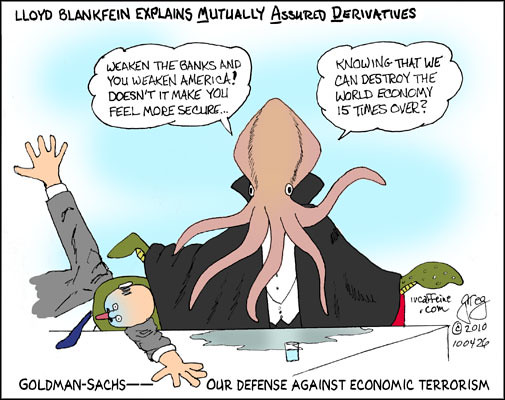
KatileighSkaneateles
There was a time when I aspired to be a client of Goldman Sachs. As the 2008 story unfolded, it became clear that your former company had taken a turn away from serving customers and, more importantly, from being a good corporate citizen. This "disease," as many have reported, continues to infect our economy and to shake our trust in financial institutions. We have a a fear of what you have confirmed: that we can't trust our money to them. Once on deposit, it ceases to be our money and becomes theirs for the taking. In most industries, leaders know that once the customers become secondary, the business compact is broken. Thank you for speaking out.
TNCSC
Lay off the man, he has publicly done the right thing at great financial (and no doubt social) cost to himself. He has a conscience. What he says about the old Goldman culture is well known and I believe the shift speaks to a broader shift in loss of shame in our culture. We now are so collectively narcissistic that the individual pursuit of money at any cost has created a risk-taking environment that is unsustainable. See this in the orders-of-magnitude increase in compensation form the 1980's to now; a billion is the new million. There is no sense of shame in making $10-100 million a year just for skimming a large transaction, but worse, there is a new sense of entitlement and belief in one's greatness born of such money.
pjuNY
In 2008, I worked for JPMorgan Chase, albeit at a lower level than Mr. Smith. I spent a year trying to tell managers that there were all kinds of abuses going on with respect to disclosures about mortgages and home equity loans. All paid me nothing more than lip service. They couldn't have cared less about the client; it was all about their bottom line. Then the housing market crashed. Surprise.
I wrote a letter to Jamie Dimon, expressing my concerns. I got a call from one of his flacks in personnel. And instead of saying we'll look into this and fix it, her question was "Well, what do you want?": corporate speak for "What do we have to do to shut you up?"
Ultimately, I left of my own accord, and permanently said goodbye to any kind of "financial service" enterprise. It may sound quaint, but I'll take my personal ethics over the almighty buck any day; it beats feeling like you need a perennial shower.
John WoodsMadison, WI
I have long felt and written about the purpose of an organization: it is to create a mutually beneficial relationship between itself and those that it serves. Whenever an organization does not do this, it undermines its long-term survival. Another thing I am sure of is that profit is a way to measure the quality of service to others because you have created a lot of value for them. Losses measure the same thing. GS is very profitable, but apparently this is because it manipulates the system and exploits its customers for its short-term gain. This is a formula for its eventual demise.
I hope this article is a wake-up call for Goldman's clients and management. If I had money with this place, I'd get it out now. If management focuses on profit rather than service, it is doing exactly the things to bring about its downfall. I seriously doubt that the current management of this place can make the changes necessary to turn this firm around. Their heads are in the wrong place. They have created this toxic culture to which their employees are adapting. I hope the board throws them out and brings in those who understand the first sentence of this comment.
Organizations are part of the larger environment and society in which they operate. They look out for themselves by looking out for that of which they are a part. GS seems to be doing all it can to destroy that environment and take itself down at the same time. Thanks to Greg Smith for calling them out.
ErkaCambridge, MA
Well, as far as I understood, scamming Greece and defrauding European budget seems very in line with the "true" GS spirit, right, since it happened 11 years ago...
SteveNew York, NY
Reflective of our entire society. I know someone who went to a Chiropractor's conference and virtually all the classes were on dealing with Medicare, insurance companies, and marketing, in order to maximize profits. No classes on new techniques or research.
BantyUpstate New York
These problems proliferate due to ubiquity. If the clients know that the firm down the street has the same practices, there's no place to go. These firms routinely benchmark against each other (there is a whole industry devoted to that kind of report) to know what their latitude is, and make sure they aren't leaving a penny on the table.
Kevin RothsteinNew York
We should have broken up the big banks after the financial meltdown. I hope clients pull all their money from Goldman after reading this article. I have more respect for loan sharks than I do for any Wall Street banker who does not represent the best interests of his clients. At least a shark does not hide what he does.
RalphNorwich, NY
Unfortunately, with the decline of pensions in America, most workers are forced to invest in 401(k) and 403(b) structures that abuse the customer. Most of the funds that are available to workers within these 401 and 403 plans are high cost, low performing mutual funds. One of the plans that we were in, did not even list all of the companies in their mutual funds. They called it “proprietary information”. How is that for arrogance and distain for the customer?
My wife and I were in different pre-tax pension plans for decades and none of the funds provided account statements that made it easy to calculate capital gains. It would have been easy for them to do, but they didn't want us to know the numbers. Most of our growth in equity was from our contributions, rather than from capital gain.
When we finally changed to IRAs in order to gain control of our investments, the mutual funds fought our efforts to move money from their funds. They set up roadblocks and threatened us with tax consequences. It takes a lot of work, discipline and research to manage one's investments. Mr. Smith confirms some reasons why retail investors have left the stock market.
DanielStockholm, Sweden
Thanks for sharing Greg, incredibly interesting - and not a big surprise really! Capitalism at its best puts the best product or service in the hands of people at the best price, through fair competition. What Greg describes seems to be the fashionable version of capitalism at the moment; short term gains, how can I profit before it all goes up in flame? How can I trick people to buy whatever I'm selling, no matter the the consequences? It is ugly. It is the self-destructive impulse of capitalism at its worst. In ancient Greece the opposite to the vice pleonexia, greed, was the virtue of justice. In ancient Rome, the word 'idiotes', meaning private citizen, could be used as a dergatory term for someone who would look at their own gain ahead of that of the community. We all know the modern word etymologically related to it..
LucaCheltenham, England
I have found that epiphanies usually occur after the youngest sibling has successfully negotiated her/her expensive college and/or the appropriate share package has matured.
Christopher DeloguLyon France
John from Philadelphia praises you as a "brave man," ok maybe, but I can't help thinking of Olympia Snowe's recent decision to leave the Senate for similar reasons of conscience and disgust with the dominate culture and thinking that her and your departures from your organizations leave a hole that is likely to be filled by someone who is more extreme and has more conformist instincts and less conscience than you. You have become such a big cheese at GS and yet feel that you, you of all people in the organization -- not exactly the junior cog -- would rather quit 'em since you claim to not be able to beat 'em, is that it? This is a sad confirmation of Tocqueville's fears about the omnipotence of the majority and the tendency of whistleblowers to be either drowned out or, as in your case, to drown themselves (Democracy in America, vol 1, part 2, chapter 7). I hope some of your GS associates who share your views stay on the job, otherwise it's just more tyranny of the majority and group polarization full speed ahead. Yikes!
David DavidNYC
Oh it must sting to be sitting in the GS HQ and to read Mr. Smith's letter just now. I left a great position to join GS some years ago, mostly out of curiosity. The firm had interviewed ~28 people for the position and thought I'd give it a shot. I drank the Kool-Aid, but wondered if the firm lived up to its ideals. In the four years that I was there, I found that it did not. When commenting to management about having observed how my colleagues would accomplish important projects at far higher costs than necessary, I was advised of two things: 1) Be more humble as I was violating the firm's "corporate culture" by being seen as "bragging" about the commercial efficiency of my transactions and enumerating the value of the cost savings achieved when compared to the decisions made by my colleagues (sometimes in the $M's). My manager would refer to these funds as inconsequential, "a rounding error" on our balance sheet; 2) That I should not worry, because "GS isn't and will never be the low cost provider of services." In doing the best that was commercially possible, my behavior wasn't consistent with the developing Goldman culture, and after four years, I was laid off. Thank goodness!
FlorettaNY
Alas, Greg, you are a voice crying in the wilderness that is modern finance. You will be considered by the elite as about as out of touch as Judge Hardy in those old Mickey Rooney movies from the 1940s. Too bad. I shudder to think what Judge Hardy would have to say about modern financiers. The words scoundrels and unpatriotic come to mind. Their loyalty is to themselves alone. For now Goldman is still living on its past reputation, but for how long? When I am not happy with the way I'm treated, I take my custom elsewhere. I suggest investors with GS do the same.

GeorgePalo Alto, CA
Dear Greg,
Thank you for your honest, heartfelt column. I find it particularly distressing because I am a Stanford student, as you once were, about to embark on my summer analyst internship at Goldman.
Maybe things are different at the top, but during my interviews, I certainly did not talk about working only to make money off the client. I knew what I was supposed to say, and to be honest, I meant it. I do want to serve clients. That is what I have done at every job I have had up until now, and for me, there is no greater satisfaction than doing a good job for someone else. We can all work for ourselves, but working for others requires a belief in a cause and deep, selfless motivation. Unlike the trash-talkers in the comments here, I do believe there is an important purpose to investment banking and finance in general, and I accepted the internship for this summer so that I could see it for myself, learn the skills that Goldman teaches so well, and decide if it was for me.
Granted, I know how much obsessing goes on in finance about who gets paid what bonus, and where people get promoted, and who has the most swagger. Yet I do not think these attributes are unique to finance. It just happens to be a magnet for ambitious people. If they have been led so astray, as you say, then I can only hope someone more visionary and ambitious will lead them back.
Now I must return to my IR paper. It's 5:30am here, and I'm still getting ready for those ibanking hours.
Best,
George
Larryat24Plymouth MA
I surely trust that you will use the funds you have received to maintain a reasonable lifestyle. Poverty is good for literary status but prevents one from affecting the world. I see this as a great victory for the people. A person of substantial skill and insight has left the bad guys with knowledge that may be used more constructively. We have huge financial issues, like when 20% of the people can produce all we need, what do we do with the rest. Our politicians can’t even understand the issues, and here we have someone that may be able to assist. A Victory! Welcome Greg, and come on over any time!

------------------------8<-----------------
* Reference to another Apple Cart
N.B. The different background colors are meant to suggest few of the dimensions of this situation.
Subscribe to:
Posts (Atom)
Popular Posts
-
 The 2nd installment of wikileaks, Cablegate , has been partially released, as in 1/000. The story behind the whole data-spill seems to hav...
 -
A little less than 3 years ago, I commented about the unfolding episode of WikLeaks . [...] a smart young man, driven by patriotism, enlis...
-
Capitalism is itself an artifact, based on a fiction. Sooner or later, it runs out. Some of its plot elements are property, law, innovatio...
-
A recent NYTimes article informs us about the Chinese plan to redirect massive amounts of water to their dry north from their wet south. H...
-
That Obama has overtaken Bush II is a fact that comes to show who's not in charge at the White House. So, as if doubling up in Afghani...
-
This past winter, during a half-day stopover in Paris, I took to its streets, wandering more or less aimlessly. Near the Archives nationale...
-
"I hear these people saying he’s like George Bush. Those people ought to be drug tested," Gibbs said. "I mean, it's crazy...
-
 I have been writing about the too big for our good capitalist entities for some time now (e.g., here ). The NewScientist features "a...
 -
I remember when I was a corporate cog waiting for the time to pass and call it a day. Until I realized it was my own time I was in effe...
-
 By Susanne Beyer and Lothar Gorris Italian novelist and semiotician Umberto Eco, who is curating a new exhibition at the Louvre in Paris, ta...


 Posts
Posts

