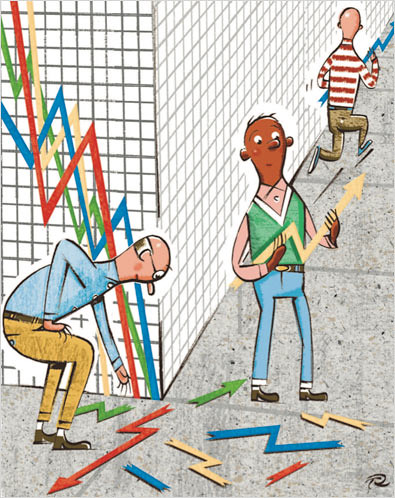
When are we told it's bad?

Well in advance? Optimistic.
Not a day too early? Cautious.
A day later? Clever; It may OVER by then.

Congressman Ron Paul compares our debt ceiling Bunraku with the following situation:
This is akin to a family "saving" $100,000 in expenses by deciding not to buy a Lamborghini, and instead getting a fully loaded Mercedes, when really their budget dictates that they need to stick with their perfectly serviceable Honda[...]  Our revenues currently stand at approximately $2.2 trillion a year and are likely to remain stagnant as the recession continues. Our outlays are $3.7 trillion and projected to grow every year. Yet we only have to go back to 2004 for federal outlays of $2.2 trillion, and the government was far from small that year. If we simply returned to that year's spending levels, which would hardly be austere, we would have a balanced budget right now. If we held the line on spending, and the economy actually did grow as estimated, the budget would balance on its own by 2015 with no cuts whatsoever. We pay 35 percent more for our military today than we did 10 years ago, for the exact same capabilities. The same could be said for the rest of the government. Why has our budget doubled in 10 years?
Now, who's the audience?  Surely US.  Outside the US, there might be those who'd still point out how responsible we are even when evidence suggested otherwise.  Yet I have a feeling that the monied outsiders are not buying in and, to get a bit speculative about it, I'd not be all surprised if Mr. Murdoch followed his doctor's advice and took up residency in some warmer and humid climate, as in HK if you get my drift.

Here in the US we are well on our way to the structural adjustment I keep talking about, e.g., here, yet the latest Bunraku play in discussion shows that the burden won't be share equally, which can make the situation very volatile.  The progressive left has been administered its 'leave politics for the lowly!'  signal, now it's the turn of the Tea Party folk to be sent packing.  Also here, as no bubble is in sight, the hope might well be that portions of the rest of the world would be become so much worse, and the more their difficulties are denominated in dollars the better, that we couldn't look so bad in comparison.  So there you have a type of OVER.  There could be many other types of OVER, but the fabricants of reality and money must have become so sure of their craft and our confusion that they are banking it all on the first kind of OVER.  For the individuals not associated with these schemes there is only one way to see the light, get back to the fundamentals!  Yup, those we've been conditioned to scorn.  In case you don't know where to start, pick up any wise text that had been written more than, say, 100 years ago.  Then, after internalizing some of that stuff, join conversations, talk back!      
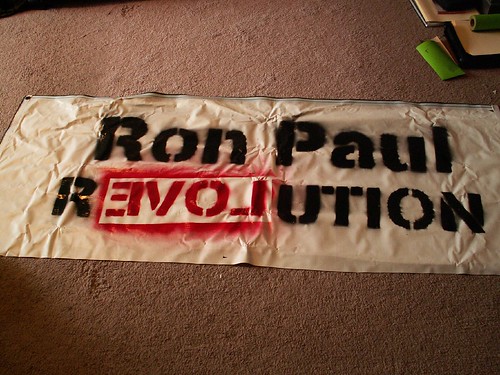

Ron Paul for President, 2008, originally uploaded by jshj.

What do you see outside?


Francis Bacon, Study for Bullfight No 2 (1969)
I think that man now realizes that he is an accident, that he is a completely futile being, that he has to play the game without reason. [...] You see, all art  has now become completely a game by which man distracts himself (Bacon-Sylvester, Interviews, pp. 28,29).


I have signaled the descent of our western system, based on economic liberalism and democracy projected to global proportions, since before its 2008 Crisis.  After three years, during which governments have saved the capitalists by imposing austerity on the populace, we are semi-officially in a 'Small Depression' according to Paul Krugman.  The ordering belief must be that in a world distracted from facts, the capitalists are the only ones to be trusted to {harness, muster, unleash, ...} {creativity, innovation, renewal, growth...}; indeed, capitalists are always selected according to their being best able to align self-interest with action, the best indicator of a well-running capitalist engine, that is.  Stimulating the economy by placing money in the hands of the populace, yours and mine, mostly increases the trade deficit--I have written this too.  Problem is that capitalists are known to buy imports too, unless they park the money in some unproductive niche. 

So, what's a government to do anymore?  A cynical may say that those populating governments are merely interested in preserving class privileges while subsidizing a nice show.  While that is true, can you think of a way out?

For example, the French and Italians citizens thought that by electing economically-liberal demagogues, growth would be assured.  I am skeptical Berlusconi or Sarkozy fulfilled any of their electoral promises.  I am equally skeptical of Cameron's prospects in the UK.

Could it be that we need to take a half-step back from globalization?  Taxing the incentive out of the financial speculation can certainly help.  This addresses in part the flexibility of capital, and the question becomes, how flexible ought capital to be?  For example, Simon Johnson, MIT professor and former Chief Economist of IMF, is not the only to suggest a tax on “excess leverage;" Tobin taxes are also quick to come to mind.   Then, shouldn't we reconsider the French idea for a reduced work load for all, thus being able to employ more?  Yes, we must also get adjusted to the idea that floating is better than sinking, while not as fun as swimming.  In the end, I don't care much about the extent to which these ideas are in agreement with one's standard of free-market capitalism, for I remind you, what we've had so far hasn't been free-market capitalism either. Don't you also find it problematic that each time one tries to argue for active management of the situation, the capitalist (ventriloquist)  counters that due to the complexity of the system, the self-adjustment capability of the markets, free of regulation and taxes, is better than any one's fallible mind? 

In any case, the above ideas are neither of the left, nor of the right.  They are about the art of living and reflecting upon it not long thereafter. 

+
It's most regrettable what happened in Oslo.  I have a feeling that just blaming Anders Behring Breivik is not going to deter forever another symptom of our common disease.  Breivik seems to have been against multiculturalism, whatever that meant in his case beyond being anti-Muslim immigration as a new form of Marxist internationalism--I know, it's a mouthful and I could use some European help to unpack it.

Shock and/or incomprehension, ensuing the massive destruction inflicted by World War I on so many, was not enough to prevent fascism or Nazism from coalescing as reaction to the dissolution of the world order, perceived then by the former as the result of the centrifugal forces of communism and/or international finance.   

As wise people have always said, and the demagogues exploited to i/a-mmoral ends, humans need to believe in something greater than, say, self-interest.  That something had better be based on moral law.  Replacing sacred religion with the secular religion of self-interest, briefly introduced as part of a moral code based on natural law by Adam Smith,  has not worked too well.  As for how religion is observed in the US, let me just say, per out tax code and all that, it's big business for a minority and of whatever comfort for most--read this last statement in terms of effectiveness.


Through my Window(s), I see Tauoromachia.  


What do these youth know and the world hasn't figured out yet?
Do the police know whom they are con/fronting, as in interfacing?
Is democracy the legitimate monopoly of power?  What makes it no longer so?
When humanism is lost, do we regress to homo homini lupus?  How do we come back?


Crepuscular Murdoch or a falling media empire?

Keith Rupert Murdoch, AC, KSG ( born 11 March 1931) is an Australian-American media mogul and the Chairman, and CEO of News Corporation.Murdoch's first permanent foray into TV was in the USA, where he created Fox Broadcasting Company in 1986. In the 2000s, he became a leading investor in satellite television, the film industry and the Internet, and purchased a leading American newspaper, The Wall Street Journal.

Rupert Murdoch was listed three times in the Time 100 as one among the most influential people in the world. He is ranked 13th most powerful person in the world in the 2010 Forbes' The World's Most Powerful People list. With a net worth of US$6.3 billion, he is ranked 117th wealthiest person in the world.

The resizing of the Murdoch media empire has just started. I think it's been payback time for a while, at least since Obama won the presidential election. While the circus took place on stage, with Obama and the other characters following their scripts, life was dandy. As the Conservatives switched places with the Progressives (recall those 8 too many years under Bush the lesser), the former needed some pacifying device; Murdoch obliged, everything looked under control while the stage and scripts were outside (Golem-like) surprise.

However, I think that some powerful figures must have gotten a bit nervous by media fueled chaotic phenomenon known as the Tea Party movement. I mean, they calmed Ron Paul down, someone who had built a credible image about fighting financial elites, and couldn't get some junior Congresspeople to toe the line? Ha, nobody should forget the Alexander Hamilton financial chapter in the history of the nation! That is, no mortal of the realm questions the financial logic.

So, I wonder where things went amiss and what Murdoch's contribution might have been.  I suspect you cannot have good Americans think they may get Congress to listen to them on such arcane matters as kicking the financial can down the road.  Could it be that Murdoch either switched masters or thought dangerously for one as if in defiance of old age?

Be that as it may, but what do you do when you've had a finger on all digital pulse?  You start by turning Murdoch in to the British, let it go down with his base here, and finally administer justice.


The most influential man in America
Are we to witness a crepuscular Murdoch or a falling media empire?  Are they going total war here?  If it's the end of the person, we shall conclude that some people don't know how to age.  Otherwise, I leave it to you, my reader(s) to figure the details of the next rise from the ashes of this media Phoenix...

re-newed public consciousness needed

piglets!, originally uploaded by swissrolli.


...are these the capitalists sucking the government, or the many taxes sucking capitalism?

Here's what Greg, from Brooklyn NY, a NYTimes reader, wrote back recently:

Democracies cannot last, because eventually the majority realizes that it can vote itself a stipend. That is where we're headed--any politician who promises to provide lavish services while cutting taxes wins in a landslide, despite the basic idiocy of that position. Eventually we will end up like Greece. Just as Greece is gradually becoming an economic colony of the EU (specifically Germany, or German banks) we will soon be an economic colony of China, to which we owe more money that we can ever possibly pay. The only alternative is to tighten our belts, pay more taxes, and accept more limited services. But we won't. The American Century is over, and with it our way of life.
It's painful, some argue that even long necessary, but we are getting there.

Consummerism: Interpreting the Signs

Day 24: Interpreting the Signs, originally uploaded by susanvg.

Via Flickr:
Stop - Female shoppers.
Stop Shopping.
Stop excessive Consummerism.
Stop - woman in high heels carrying too many bags crossing the street. Making meaning.


Consummerism


Article 25 of the Universal Declaration of Human Rights 
Everyone has the right to a standard of living adequate for the health and well-being of himself and of his family, including food, clothing, housing and medical care and necessary social services, and the right to security in the event of unemployment, sickness, disability, widowhood, old age or other lack of livelihood in circumstances beyond his control.

The United Nations General Assembly ratified Article 25 on Dec. 10, 1948.


Paradigm Shift

Stephen Walt looks at 9 centrifugal developments rearranging the world now.  Here they are in short line versions, italicized, followed by my comments:


1. The financial crisis has put the Eurozone under unprecedented stress, and the European Union's future looks increasingly bleak.


We've made EUro-pe a gift it couldn't resist, the Greek crisis.  I'm not sure about the Germans' role in this, nor the French capitulation from pulling its traditionally pro-European levers.  Are the Germans finally setting themselves free of the post-WWII system of checks and balances, or they've learned how to play the IMF to their advantage?


2. NATO looks more and more obsolescent.

 The money has run out at the underwriting center of the alliance, while the rest have grown entitled to its benefits.


3. The Arab world is in upheaval, and seems likely to remain unsettled for years.

I wrote here that things were entering the territory of luck. I wrote elsewhere that I saw the whole thing as a measure of our despair.


4. In fact, the "Arab spring" has done nothing to improve the U.S. image in the region.

The departure of Mubarak has put many on notice, they are nervous about it and closing ranks.  Thus, we pay more for gas at the pump.  Sure, it's got nothing to do with current supply-demand, but the smell of gunpowder in the oil lands.  The Chinese are watching.


5. There may be a mounting power struggle in Iran, but its slow march toward a latent nuclear capability continues. 


Wishful thinking--Clinton should have taken the Iranian hand when we were offered; as of now, we've got no leverage with the alternative power structures there.

6. The Afghan War will end -- but not soon -- and we will leave behind a dysfunctional country, a nuclear-armed Pakistan, and a lot of people who will either be angry for us for what we did or angry at us for what we failed to do.

Not knowing when to enter, what to do, and when the get out of wars is a sign of a dysfunctional military policy.  The tail wags the dog, or the military action is the best diversion each time the honchos on Wall Street and in DC run out of options.


7. Japan -- which is still the world's third largest economy -- has suffered nearly two decades of economic stagnation and a costly nuclear disaster.


Japan is going its way, they must be looking for that way as we speak.  They must have loved us so much that only their inertia is keeping that door from kicking our rear ends.  Common values?  Let's call that for short, the world order of the dollar.   


8. China continues to rack up impressive rates of economic growth -- despite some signs of strain -- and it has avoided the foreign policy sinkholes that Washington has specialized in for the past two decades.


China operates with different scales.  We have not developed a sense for how they think, nor who they are.  Which is quite the opposite viewed from their end.  The game is theirs, and many a US friend is looking up, openly or not, for the day they can play China against the US for a better place at the table.  How things are going to be sorted out in Libya is likely to be the answer of the world to come. 

We have the first post WWII generation to make it into the White House and the executive offices around the country to thank for this.  Small-world minded, deluded by the "world is flat" platitudes, overconfident, and self-important.  They  wasted most of the hard work, lessons of history, good will of the world and other national intrinsic assets, all built over many decades since the 1930s.


9. As these various problems mount, America's political institutions seem increasingly paralyzed.

This is the symptom of a country that stopped learning because the feedback supposed to help us correct and improve had been distorted by the imaginary mind games our elites indulged themselves and led everybody else into.  For example, recall the idea circulated early during our Iraq invasion in the Bush administration, reality doesn't matter, what we say it is becomes reality.  This was rather the expression of how detached we've become from reality, not some play on words by those funny academics feeding Bush options.

Walt opens his thoughts with Yates' poem:


Turning and turning in the widening gyre
The falcon cannot hear the falconer;
Things fall apart; the centre cannot hold;
Mere anarchy is loosed upon the world,
The blood-dimmed tide is loosed, and everywhere
The ceremony of innocence is drowned;
The best lack all conviction, while the worst
Are full of passionate intensity.
..


For the full text on each one of the above, follow the pointer to Walt's blog with Foreign Policy.

The many lives of an idea(list)

In the spring of 2008, I raised the following question/topic on LinkedIn:

...too much money got into the hands of too many people too fast?

Considering all current and near-future dramatic developments (e.g. environment, prices, trust in financial markets, etc.) could one argue that the world is trying to heal a disease whose symptoms include "too much money got into the hands of too many people too fast?"
People kind of got the idea, but not exactly--follow the above link to see for yourself.  Had I raised the same question today, probably the answers would be different.  But this is not the main point, for I've gotten used to waiting until people pass corners so they see what I sometimes talk about.  The main point is how this little episode illustrates again what Keynes said:

The ideas of economists and political philosophers, both when they are right and when they are wrong, are more powerful than is commonly understood...
Practical men, who believe themselves to be quite exempt from any intellectual influences, are usually the slaves of some defunct economist.
Case in point, I've just discovered this:
In a 1930 essay titled “Economic Possibilities for our Grandchildren,” John Maynard Keynes ridiculed economists for having a high opinion of themselves and their work. As the Great Depression engulfed the world, Keynes looked back at historic rates of economic growth, arguing that the real problem people would face in the future was not poverty but the moral quandary of how to live in a society of such abundance and wealth that work would cease to be necessary. The “economic problem,” as he put it, was technical, unimportant in the larger scheme of things. “If economists,” he wrote, “could manage to get themselves thought of as humble, competent people, on a level with dentists, that would be splendid!” (source: The Nation)
I could have described the problem I saw also in moral terms, yet I must have chosen to operate with the discursive tools of the time and place;  LinkedIn being a professional network, moral argument does not weigh as much as money--I wonder if anything changed  In essence, I stumbled upon the footprints of a defunct economist.


白隠

Obama's put option

NYTimes has a piece on the weak economic recovery:

Economy’s Woes Shift the Focus of Budget
By JACKIE CALMES
Recent signs that the economic recovery is flagging have introduced a new tension into the bipartisan budget negotiations.

The general assumption, which I have not shared, is that the money handed to banksters was meant to stimulate economic recovery to pre-2008 levels.  I argued here that our non-bubble economy has shrunk and people become unskilled to the point that the trillions spent by Bush and Obama could only be intended to prop the status qvo ante. Why are people looking for reversing a trend? Because they were told so.  Like in the past, except that our money is increasingly perceived as mostly backed by paper, by those who push gold above $15oo or switch from dollars to other currencies.

After the .com bubble there has been little in terms of sustainable economy that could use stimulus. Let's not forget, bubble money went into the real-estate and war economies. This had taken place while the effects of offshoring were masked by cheap (also subsidized) imports.

Some wake up now and ask for stimulus, yet others in the world have been awake, at least since the crisis in 2008. The latter are not willing to finance us anymore, hence the difficulty of dancing round the deficit vs. stimulus opposite poles.

I think those who fight deficits aim at accomplishing several things, of which one is ignored in the current debate: the external credibility of our system. I'm afraid that's been eroded and we are only seeing how people take calculated steps away from US. The recent Libyan episode is but an incomplete exception, which may itself prove to be temporary.

So, while I can understand why there isn't and won't be a stimulus, I cannot understand why
  1. People expect more stimulus, though it takes one to learn; 
  2. People like Krugman call for more stimulus, since he's a learned man;
  3. The burden is not equally shared. By this, I mean the absence of higher taxation at the top, as in progressive tax.  A VAT system, excluding those items that the lower income people depend on, may also be an option.
What are we afraid of? That everybody with money is going to start learning Chinese? I'm more apprehensive about Geithner's keeping his job, for he is Obama's put option on the status qvo.

________________
A version of this has been posted at the NYTimes blog.

Popular Posts