Showing posts sorted by date for query tax. Sort by relevance Show all posts

Bubble tea, tea or Coca-Cola?

This past winter, during a half-day stopover in Paris, I took to its streets, wandering more or less aimlessly. Near the Archives nationales I went into a boutique de thé, tea shop, where I must have spent more than a half-hour going through three large rooms whose walls were lined up with teas of all kinds. I concluded with one of the three sales ladies that we must have entered the Asian century since we were talking theine in France, a place associated rather with tannin.

The tea shop

The post-WWII era is coming to an end. Its most taken for granted institutions, (e.g., the US dollar, NATO, IMF, etc.) and ideologies (globalization, neo-liberalism, etc.) have come under stress, and I take the advent of tea as another sign of the growing Chinese/Asian influence. Such signs can give us an idea-set about one of the directions the world may go into. Our own history, in the western market democracies, that is, gives the complementary directions.

It is not easy to foretell if, let alone how, the world turns Asian. If the capitalist model of growth, based on credit, fiat money and inflation, proves to be irresistible, the Chinese still need to put a lot of work into building up a worldwide financial system, with rules and institutions. This kind of work takes decades and/or catastrophic event(s) to bear fruit.  The attractiveness of the Chinese economy in a capitalist scenario consists of its being able to theoretically contain larger bubbles than the rest of world.  In fact, the world seems headed into a hyper-capitalist direction where countries assemble in blocs and the individual economic entities grow even more.  On its current iteration, the EUro bloc stumbled by being just as resilient as its most exposed economy.  If the EUro picks up steam again, the US will have to count its friends and integrate accordingly.    

From the western history lessons , one should be reminded, if not told, that market democracies had gone through at least one crisis, similar to the one started in 2008, in the beginning of the 20th century, when the international and national versions of socialism looked like better alternatives to the capitalism that worked for fewer and fewer at the expense of most. Communism and Nazism, those being the two versions of socialism introduced above, had their constituencies even in Britain, still the bastion of capitalism at the time--in fact, there were even top royal British figures flirting with Nazism, while Churchill, the ever ideologically-swinging opportunist, found a vocation in opposing Nazism.


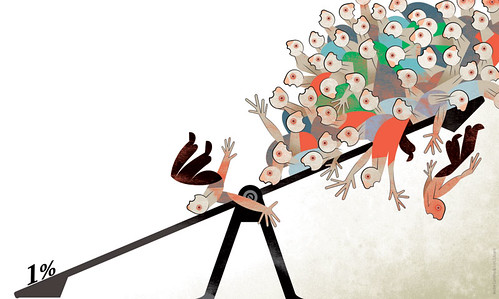
The 99%


In an economical system predicated on limitless growth, problems on the home front start brewing when the system relegates the willing and educated to un/under-employment.  Lack of labor competitiveness can work as justification for only so long before these educated folks give ideological shape to the general dissatisfaction with neo-liberal globalization (e.g., trade liberalization, exchange rate controls, and tax-free flow of money).  The western elites (aka 1%) are fully aware of all this, and the never-ending war on terror is just a cover for how far the elites have been willing to go to defend the status qvo ante 2008.  Another means to counter the emergence of an opposition to neo-liberal globalization is to quickly consider any alternative as enemy of civilization--you know the usual suspects, extremism, nationalism, socialism, totalitarianism, isolationism, etc.  

Also, the S-Ir(i)anian diversions can only take us on collision (or is it collusion?) course with China and Russia.  While the Russians have been neatly folded in the world system, and the Chinese have risen within the world system, they show signs of nervousness about their positions relative to the hegemon.  Strictly on military terms, the US is still ahead, but otherwise, the defection of Germany and/or Japan to side with the challengers can signal continental shifts.  Collision is therefore likely to take place through proxies, whereas collusion would give the challengers first right of refusal over certain places on Earth.  Of course, the challengers ought to also face their own internal problems--the Russians have to learn how to live with lowering commodity prices, whereas the Chinese are not anywhere close to having developed a viable growth model/alternative at national scale, let alone planetary scale--but then again, who's gonna call their bluff?  The existing credit rating agencies and/or Basel III type of capital requirements... or rather plenty of regional conflicts to the effect of Brzezinskian creative volatility.      

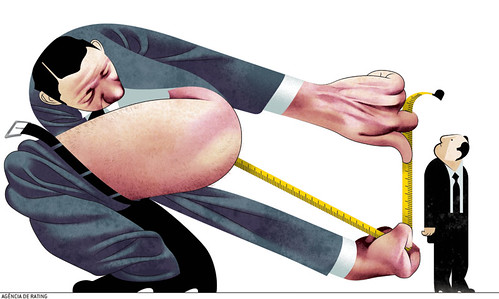
Credit rating agency

To return to the US, the bromides of eventually operating markets, be those economic or political, are wearing thin.  In fact, markets are social constructs that need constant oversight under the guidance of whatever socially accepted principles.  There is nothing intrinsic to markets that prevents the capitalist excess on its way up or down; markets make only a nice abstraction behind which the few tax the most with impunity.  Meanwhile, the US academics, busying as usual with minute correlations, are still to catch up with the enormity of the task.  One of the difficulties is the epistemological bias against systemic, or ecological, treatment of the problem.  Time for change in the ivory towers will come as the higher-ed bubble may lose some air given the job market difficulties of the ever more indebted graduates.  However, Americans overall are catching up--a search by "crisis economics" on Amazon.com yields  57,557 results as of this writing.  

So, what seems sensible to do?  The Occupy movements and the libertarians are just too conceptually fragile to make any progress, given how time changes things.  A locally verified solution of the capitalist excess would be something akin to the New Deal.  Rather than plunge ourselves down the spiral of destitution and despair for not having a Steve Jobs among each fifty-thousand of us, we could stop thinking in terms of labor competitiveness on a global scale for as long as the jobs match the skills and the fruits of labor enable the best of us to take the whole economy to the next level up.  Turning a blind eye to the under-educated immigrants can only depress incomes of the locals, preventing most American children from becoming the next Steve Jobs.  Also, good healthcare and education ought to be  human rights, not a matter of personal income.  


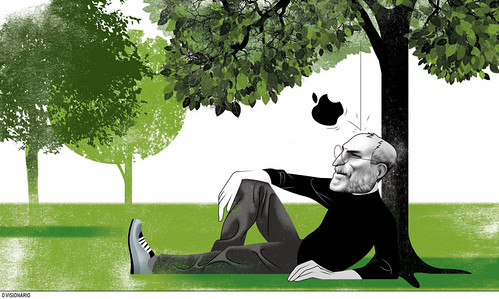
Steve Jobs, visionary


Another new deal requires that the American elite adopt a historically informed perspective, which the current generation of leaders is found missing.  There are also notable exceptions, such as Felix Rohatyn, of course, of a different generation, whose 2009 book offers a blueprint that's workable within the current system.  

In closing, before we decide on the type of beverage for the next course, I include an extended reference from Minqi Li, a scholar (Chinese-American?) whose pivotal perspective complements, if not supplants, many in sketching the politico-economical landscape ahead.


MINQI LI pdf


Please note that Minqi Li indicates that the planet may not sustain a bubble tea, regardless of the capitalist logic of the global investor.

Global warming


An apple from the G(B)S Cart*

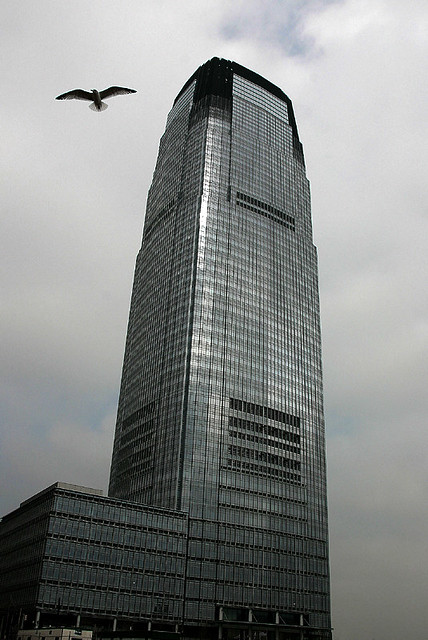
Goldman Sachs @ 20mm


GREG SMITH has recently come out with the his reasons for leaving Goldman Sachs.  Following is his open letter.


TODAY is my last day at Goldman Sachs. After almost 12 years at the firm — first as a summer intern while at Stanford, then in New York for 10 years, and now in London — I believe I have worked here long enough to understand the trajectory of its culture, its people and its identity. And I can honestly say that the environment now is as toxic and destructive as I have ever seen it.

To put the problem in the simplest terms, the interests of the client continue to be sidelined in the way the firm operates and thinks about making money. Goldman Sachs is one of the world’s largest and most important investment banks and it is too integral to global finance to continue to act this way. The firm has veered so far from the place I joined right out of college that I can no longer in good conscience say that I identify with what it stands for.

It might sound surprising to a skeptical public, but culture was always a vital part of Goldman Sachs’s success. It revolved around teamwork, integrity, a spirit of humility, and always doing right by our clients. The culture was the secret sauce that made this place great and allowed us to earn our clients’ trust for 143 years. It wasn’t just about making money; this alone will not sustain a firm for so long. It had something to do with pride and belief in the organization. I am sad to say that I look around today and see virtually no trace of the culture that made me love working for this firm for many years. I no longer have the pride, or the belief.

But this was not always the case. For more than a decade I recruited and mentored candidates through our grueling interview process. I was selected as one of 10 people (out of a firm of more than 30,000) to appear on our recruiting video, which is played on every college campus we visit around the world. In 2006 I managed the summer intern program in sales and trading in New York for the 80 college students who made the cut, out of the thousands who applied.

I knew it was time to leave when I realized I could no longer look students in the eye and tell them what a great place this was to work.

When the history books are written about Goldman Sachs, they may reflect that the current chief executive officer, Lloyd C. Blankfein, and the president, Gary D. Cohn, lost hold of the firm’s culture on their watch. I truly believe that this decline in the firm’s moral fiber represents the single most serious threat to its long-run survival.

Over the course of my career I have had the privilege of advising two of the largest hedge funds on the planet, five of the largest asset managers in the United States, and three of the most prominent sovereign wealth funds in the Middle East and Asia. My clients have a total asset base of more than a trillion dollars. I have always taken a lot of pride in advising my clients to do what I believe is right for them, even if it means less money for the firm. This view is becoming increasingly unpopular at Goldman Sachs. Another sign that it was time to leave.

How did we get here? The firm changed the way it thought about leadership. Leadership used to be about ideas, setting an example and doing the right thing. Today, if you make enough money for the firm (and are not currently an ax murderer) you will be promoted into a position of influence.

What are three quick ways to become a leader? a) Execute on the firm’s “axes,” which is Goldman-speak for persuading your clients to invest in the stocks or other products that we are trying to get rid of because they are not seen as having a lot of potential profit. b) “Hunt Elephants.” In English: get your clients — some of whom are sophisticated, and some of whom aren’t — to trade whatever will bring the biggest profit to Goldman. Call me old-fashioned, but I don’t like selling my clients a product that is wrong for them. c) Find yourself sitting in a seat where your job is to trade any illiquid, opaque product with a three-letter acronym.

Today, many of these leaders display a Goldman Sachs culture quotient of exactly zero percent. I attend derivatives sales meetings where not one single minute is spent asking questions about how we can help clients. It’s purely about how we can make the most possible money off of them. If you were an alien from Mars and sat in on one of these meetings, you would believe that a client’s success or progress was not part of the thought process at all.

It makes me ill how callously people talk about ripping their clients off. Over the last 12 months I have seen five different managing directors refer to their own clients as “muppets,” sometimes over internal e-mail. Even after the S.E.C., Fabulous Fab, Abacus, God’s work, Carl Levin, Vampire Squids? No humility? I mean, come on. Integrity? It is eroding. I don’t know of any illegal behavior, but will people push the envelope and pitch lucrative and complicated products to clients even if they are not the simplest investments or the ones most directly aligned with the client’s goals? Absolutely. Every day, in fact.

It astounds me how little senior management gets a basic truth: If clients don’t trust you they will eventually stop doing business with you. It doesn’t matter how smart you are.

These days, the most common question I get from junior analysts about derivatives is, “How much money did we make off the client?” It bothers me every time I hear it, because it is a clear reflection of what they are observing from their leaders about the way they should behave. Now project 10 years into the future: You don’t have to be a rocket scientist to figure out that the junior analyst sitting quietly in the corner of the room hearing about “muppets,” “ripping eyeballs out” and “getting paid” doesn’t exactly turn into a model citizen.

When I was a first-year analyst I didn’t know where the bathroom was, or how to tie my shoelaces. I was taught to be concerned with learning the ropes, finding out what a derivative was, understanding finance, getting to know our clients and what motivated them, learning how they defined success and what we could do to help them get there.

My proudest moments in life — getting a full scholarship to go from South Africa to Stanford University, being selected as a Rhodes Scholar national finalist, winning a bronze medal for table tennis at the Maccabiah Games in Israel, known as the Jewish Olympics — have all come through hard work, with no shortcuts. Goldman Sachs today has become too much about shortcuts and not enough about achievement. It just doesn’t feel right to me anymore.

I hope this can be a wake-up call to the board of directors. Make the client the focal point of your business again. Without clients you will not make money. In fact, you will not exist. Weed out the morally bankrupt people, no matter how much money they make for the firm. And get the culture right again, so people want to work here for the right reasons. People who care only about making money will not sustain this firm — or the trust of its clients — for very much longer.

Greg Smith resigned from the position of   executive director and head of the Goldman Sachs' United States equity derivatives business in Europe, the Middle East and Africa.

--------------------------8<------------------------

The NYTimes readers said the following:

GT LaBordeBirmingham, AL
Thank you, Greg for speaking out. I have been a Goldman client since 2006, and have been trying to get my money out for several years now, to no avail. My money was placed in proprietary funds that have under-performed other similar investments and were clearly designed to maximize Goldman's profit at my expense. I am not allowed to get money out of these investments, in some cases for up to 8-10 years, without a significant "haircut" (hmmm, I wonder if Goldman partners profit from the haircut??).


In one of these investments (which has lost 35% of its value since 2008), Goldman even refuses to provide basic information, like estimates of income or expenses for tax planning purposes. I literally have to guess the income my K-1 will show when I file my taxes in April, because Goldman won't even give me an estimate (much less quarterly or annual commentary or disclosure by the fund managers). In many years, the fund shows substantial interest income (on which I have to pay taxes), but none of that income is ever distributed to me and the NAV of the fund simultaneously goes down. Where did the income go? When asked, Goldman refuses to provide specifics (even though I am a limited partner of the investment partnership and have a right to this information).


It is amazing how little Goldman cares about its customers. Goldman exists for the sole purpose of enriching its partners.


Goldman Sachs Stole my Candy


amcCincinnati
Congratulations, Greg!

I resigned from more than one company where integrity was seriously lacking. In my first position, I was ordered to help clients lie on financial statements and change invoices - the partner actually handed me a bottle of white out! I was ordered to be a part of hiding a pension shortfall that I discovered and was walked out for refusing to go along.

I have paid a price for walking away from these 'great opportunities', but I sleep well at night. You are brave to take a stand for your clients and for your own integrity. I applaud you for walking away and for speaking out.


JimNew York
Congratulations Greg. I hope your coworkers read the NYT. I'm sure they will have a good chuckle and maybe a nanosecond of self-reflection. If the financial catastrophe of the last few years did not affect them, I doubt your farewell letter will. They need tighter regulation and oversight, and less gullible clients. Does anyone really question why the Occupy Wall Street movement started?


dprCalifornia
I believe the change in culture you've seen at Goldman Sachs is just a reflection of the change that has taken place in our national culture over the last few decades. When I was growing up, no one considered a person's wealth to be an absolute measure of his or her worth to society. Now, for a large part of our culture, that has changed; the acquisition of wealth is seen as good, no matter how it is achieved.

Money-grubbing behavior is rewarded, and victims of such behavior are considered fair game, not just at Goldman Sachs, but everywhere. My cable company charges huge fees out of proportion to what it delivers, but fails to adequately staff customer service to field complaints. My bank has added ridiculous fees for just about everything except were expressly prohibited by law. I am put on hold for large swaths of time to get just about anything fixed. There is a fervor for ever more tax cuts for the wealthy, paid for on the backs of the middle class.

Our whole attitude about what is important has changed, and in my opinion, not for the better.


payaegerVienna
A moral decision is to be commended regardless of circumstance; coming of age in a culture that prizes the making of money to the exclusion of everything else makes reaching such a decision doubly difficult. Mr Smith is to be congratulated for his personal revelation.
However, the survival of the company pales next to the slow-motion chaos into which this behavior - by no means confined to GS - plunges the real world on a regular basis. Of course it's very clear that those responsible are not the least bit interested, for reasons mentioned in the article.
If Mr Smith is interested in clearing his conscience, he might consider working to advance real regulation of the industry - at the very least.


James StrangeCanton, Connecticut
Unfortunately my factory-working friends who took such a big hit in this latest recession don't read the NY Times. If they saw Smith's article they might then begin to see that it wasn't big government deficits that brought down the economy but this Wall Street "take the money and run" mentality. It's the way American CEOs run our corporations and it is this mentality that destroys morale all the way down to the factory floor.


Paul Cohen, Hartford CT


Mr. Smith,


What took you so long to have this epiphany? Why do you think Goldman Sachs and the rest of Wall Street bankrolls legions of high-priced lobbyists in Washington? To protect its clients and consumers? And show me one large financial services firm that places the interests of the client ahead of its profit motives? Do you plan on returning any of your large bonuses (gratis your fellow con artists) back to your clients as an apology? If not, how about the taxpayers? Forgive me for being so cynical, but gag me.


John Riley, Atlanta, GA, In reply to Paul Cohen
I don't think you attack on Mr. Smith is called for.


It takes a long time for people to come to the painful realization that the place you have dedicated your career to is morally bankrupt, and not worthy of your time or energy. Mr. Smith realized this, and left in a way where he would expose much of the misaligned culture, and hopefully bring about resolution. That takes courage.


In my view, if he, regardless of the company as a whole, worked in the interests of his clients, then he should be entitled to his bonuses. I would agree that the company as a whole is too money-focused, and that many of the wrong people are getting lavish bonuses, but he just committed career suicide. I would say Mr. Smith can keep his. Additionally, Goldman Sachs has also repaid their entire TARP loan, so there is no need for him to "repay the taxpayers".


James WattAtlanta, Ga
I am impressed not only with your honesty but your courage to give others insight and to remind them 'honesty' is a gift you give yourself so it's easy to lose forever. And of course your intelligence to leave. It is sad today our financial and political leaders lost sight of the prime directive. "Do NO Harm". and replaced it with "Make A Buck." regardless of the method. But then again in a society where dishonesty is not only tolerated but also toasted at the finest restaurants, clubs and churches of the Western World surprise is not the reaction but has been replaced by desire.


timcornbarrington il
It's more than ten years old , but I've read the very same story before: 'Liar's Poker,' by Michael Lewis. Or look around. As an economic culture, we've stopped being stewards of the land and started being cannibals.


TonyLx
I find that these testimonials are important to help change the corrupt and rotten financial culture that surrounds our society. The sad part is that a company like Goldman Sachs has far too much power and controls not only the wealth of the wealthier, but also the wealth of independent countries. After the 2008 collapse, independent States all over the world have injected huge amounts of tax payers' money to cover for the blatant mistakes and greed of Goldman Sachs (and others). Now the people of the more vulnerable States, which little industrial and productive power, are being sacrificed so that this spiral of lunacy can continue. As a citizen of one of these countries that is being sacrificed - Portugal - I demand that my elected leaders stop pampering for these lunatic companies like Goldman Sachs and stop imposing harsh austerity measures that will lead us nowhere and will only destroy the social fabric of our country. However, I fear that this will not happen, because as we saw in Italy and Greece, when elected leaders stop cooperating with these powers they are simply replaced by former Goldman Sachs executives...sad world we are living in.


John W.Philadelphia
Brave man -- its one of the hardest things to do to rebel against culture like this at a company. Sometimes you have to publicly resign in order to make a point, and its good to hear the truth about what is really happening now at these firms. I am not sure many are going to exist soon (we've already lost many, like Bear Stearns), and I am not sure thats a bad thing. Power without any ethics or morality is always a dangerous thing, and these companies wield enormous influence over our banking system.


THMN
I don't think things have changed that much at GS in the last 12 years. He must have joined right after the internet bubble collapsed, which GS was a big part of, hyping companies that had no real business plan. And then they moved right on to double-dealing toxic mortgage products. So the only thing that might have changed in the last 12 years isn't GS' culture but Mr. Smith's assessment of that culture.
The thing that really changed GS is the change from a partnership to a public company in 1999, just before Mr. Smith joined. Suddenly, the risks are off-loaded from leadership to shareholders, quarterly earnings become the focus, and management is free to wheel & deal any way they want to with little consequence to them. That has created a huge moral hazard and nothing is being done to control that.


Katherine in PAPhiladelphia, PA
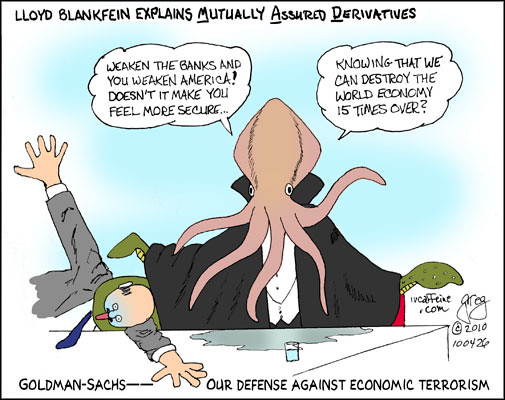
This is what happens when traders (many of whom would step on their grandmother for a profit) take over a firm that is basically a relationship business. Bravo to Mr. Smith for pulling back to curtain on this toxic enterprise that absolutely used to be one of the most respected firms on the planet. No more. Matt Taibbi had it exactly right with his "vampire squid" description. Washington: Are you listening? Isn't it high time to put some of these hot shots away?

100426-goldman-sachs-vampire-squid

KatileighSkaneateles
There was a time when I aspired to be a client of Goldman Sachs. As the 2008 story unfolded, it became clear that your former company had taken a turn away from serving customers and, more importantly, from being a good corporate citizen. This "disease," as many have reported, continues to infect our economy and to shake our trust in financial institutions. We have a a fear of what you have confirmed: that we can't trust our money to them. Once on deposit, it ceases to be our money and becomes theirs for the taking. In most industries, leaders know that once the customers become secondary, the business compact is broken. Thank you for speaking out.


TNCSC
Lay off the man, he has publicly done the right thing at great financial (and no doubt social) cost to himself. He has a conscience. What he says about the old Goldman culture is well known and I believe the shift speaks to a broader shift in loss of shame in our culture. We now are so collectively narcissistic that the individual pursuit of money at any cost has created a risk-taking environment that is unsustainable. See this in the orders-of-magnitude increase in compensation form the 1980's to now; a billion is the new million. There is no sense of shame in making $10-100 million a year just for skimming a large transaction, but worse, there is a new sense of entitlement and belief in one's greatness born of such money.


pjuNY
In 2008, I worked for JPMorgan Chase, albeit at a lower level than Mr. Smith. I spent a year trying to tell managers that there were all kinds of abuses going on with respect to disclosures about mortgages and home equity loans. All paid me nothing more than lip service. They couldn't have cared less about the client; it was all about their bottom line. Then the housing market crashed. Surprise.


I wrote a letter to Jamie Dimon, expressing my concerns. I got a call from one of his flacks in personnel. And instead of saying we'll look into this and fix it, her question was "Well, what do you want?": corporate speak for "What do we have to do to shut you up?"


Ultimately, I left of my own accord, and permanently said goodbye to any kind of "financial service" enterprise. It may sound quaint, but I'll take my personal ethics over the almighty buck any day; it beats feeling like you need a perennial shower.


John WoodsMadison, WI
I have long felt and written about the purpose of an organization: it is to create a mutually beneficial relationship between itself and those that it serves. Whenever an organization does not do this, it undermines its long-term survival. Another thing I am sure of is that profit is a way to measure the quality of service to others because you have created a lot of value for them. Losses measure the same thing. GS is very profitable, but apparently this is because it manipulates the system and exploits its customers for its short-term gain. This is a formula for its eventual demise.

I hope this article is a wake-up call for Goldman's clients and management. If I had money with this place, I'd get it out now. If management focuses on profit rather than service, it is doing exactly the things to bring about its downfall. I seriously doubt that the current management of this place can make the changes necessary to turn this firm around. Their heads are in the wrong place. They have created this toxic culture to which their employees are adapting. I hope the board throws them out and brings in those who understand the first sentence of this comment.

Organizations are part of the larger environment and society in which they operate. They look out for themselves by looking out for that of which they are a part. GS seems to be doing all it can to destroy that environment and take itself down at the same time. Thanks to Greg Smith for calling them out.


ErkaCambridge, MA
Well, as far as I understood, scamming Greece and defrauding European budget seems very in line with the "true" GS spirit, right, since it happened 11 years ago...


SteveNew York, NY
Reflective of our entire society. I know someone who went to a Chiropractor's conference and virtually all the classes were on dealing with Medicare, insurance companies, and marketing, in order to maximize profits. No classes on new techniques or research.


BantyUpstate New York
These problems proliferate due to ubiquity. If the clients know that the firm down the street has the same practices, there's no place to go. These firms routinely benchmark against each other (there is a whole industry devoted to that kind of report) to know what their latitude is, and make sure they aren't leaving a penny on the table.


Kevin RothsteinNew York

We should have broken up the big banks after the financial meltdown. I hope clients pull all their money from Goldman after reading this article. I have more respect for loan sharks than I do for any Wall Street banker who does not represent the best interests of his clients. At least a shark does not hide what he does.


RalphNorwich, NY
Unfortunately, with the decline of pensions in America, most workers are forced to invest in 401(k) and 403(b) structures that abuse the customer. Most of the funds that are available to workers within these 401 and 403 plans are high cost, low performing mutual funds. One of the plans that we were in, did not even list all of the companies in their mutual funds. They called it “proprietary information”. How is that for arrogance and distain for the customer?

My wife and I were in different pre-tax pension plans for decades and none of the funds provided account statements that made it easy to calculate capital gains. It would have been easy for them to do, but they didn't want us to know the numbers. Most of our growth in equity was from our contributions, rather than from capital gain.

When we finally changed to IRAs in order to gain control of our investments, the mutual funds fought our efforts to move money from their funds. They set up roadblocks and threatened us with tax consequences. It takes a lot of work, discipline and research to manage one's investments. Mr. Smith confirms some reasons why retail investors have left the stock market.


DanielStockholm, Sweden
Thanks for sharing Greg, incredibly interesting - and not a big surprise really! Capitalism at its best puts the best product or service in the hands of people at the best price, through fair competition. What Greg describes seems to be the fashionable version of capitalism at the moment; short term gains, how can I profit before it all goes up in flame? How can I trick people to buy whatever I'm selling, no matter the the consequences? It is ugly. It is the self-destructive impulse of capitalism at its worst. In ancient Greece the opposite to the vice pleonexia, greed, was the virtue of justice. In ancient Rome, the word 'idiotes', meaning private citizen, could be used as a dergatory term for someone who would look at their own gain ahead of that of the community. We all know the modern word etymologically related to it..


LucaCheltenham, England
I have found that epiphanies usually occur after the youngest sibling has successfully negotiated her/her expensive college and/or the appropriate share package has matured.


Christopher DeloguLyon France
John from Philadelphia praises you as a "brave man," ok maybe, but I can't help thinking of Olympia Snowe's recent decision to leave the Senate for similar reasons of conscience and disgust with the dominate culture and thinking that her and your departures from your organizations leave a hole that is likely to be filled by someone who is more extreme and has more conformist instincts and less conscience than you. You have become such a big cheese at GS and yet feel that you, you of all people in the organization -- not exactly the junior cog -- would rather quit 'em since you claim to not be able to beat 'em, is that it? This is a sad confirmation of Tocqueville's fears about the omnipotence of the majority and the tendency of whistleblowers to be either drowned out or, as in your case, to drown themselves (Democracy in America, vol 1, part 2, chapter 7). I hope some of your GS associates who share your views stay on the job, otherwise it's just more tyranny of the majority and group polarization full speed ahead. Yikes!


David DavidNYC
Oh it must sting to be sitting in the GS HQ and to read Mr. Smith's letter just now. I left a great position to join GS some years ago, mostly out of curiosity. The firm had interviewed ~28 people for the position and thought I'd give it a shot. I drank the Kool-Aid, but wondered if the firm lived up to its ideals. In the four years that I was there, I found that it did not. When commenting to management about having observed how my colleagues would accomplish important projects at far higher costs than necessary, I was advised of two things: 1) Be more humble as I was violating the firm's "corporate culture" by being seen as "bragging" about the commercial efficiency of my transactions and enumerating the value of the cost savings achieved when compared to the decisions made by my colleagues (sometimes in the $M's). My manager would refer to these funds as inconsequential, "a rounding error" on our balance sheet; 2) That I should not worry, because "GS isn't and will never be the low cost provider of services." In doing the best that was commercially possible, my behavior wasn't consistent with the developing Goldman culture, and after four years, I was laid off. Thank goodness!


FlorettaNY
Alas, Greg, you are a voice crying in the wilderness that is modern finance. You will be considered by the elite as about as out of touch as Judge Hardy in those old Mickey Rooney movies from the 1940s. Too bad. I shudder to think what Judge Hardy would have to say about modern financiers. The words scoundrels and unpatriotic come to mind. Their loyalty is to themselves alone. For now Goldman is still living on its past reputation, but for how long? When I am not happy with the way I'm treated, I take my custom elsewhere. I suggest investors with GS do the same.


Goldman Sachs 2011, luxorium


GeorgePalo Alto, CA


Dear Greg,


Thank you for your honest, heartfelt column. I find it particularly distressing because I am a Stanford student, as you once were, about to embark on my summer analyst internship at Goldman.


Maybe things are different at the top, but during my interviews, I certainly did not talk about working only to make money off the client. I knew what I was supposed to say, and to be honest, I meant it. I do want to serve clients. That is what I have done at every job I have had up until now, and for me, there is no greater satisfaction than doing a good job for someone else. We can all work for ourselves, but working for others requires a belief in a cause and deep, selfless motivation. Unlike the trash-talkers in the comments here, I do believe there is an important purpose to investment banking and finance in general, and I accepted the internship for this summer so that I could see it for myself, learn the skills that Goldman teaches so well, and decide if it was for me.


Granted, I know how much obsessing goes on in finance about who gets paid what bonus, and where people get promoted, and who has the most swagger. Yet I do not think these attributes are unique to finance. It just happens to be a magnet for ambitious people. If they have been led so astray, as you say, then I can only hope someone more visionary and ambitious will lead them back.


Now I must return to my IR paper. It's 5:30am here, and I'm still getting ready for those ibanking hours.


Best,
George

Larryat24Plymouth MA
I surely trust that you will use the funds you have received to maintain a reasonable lifestyle. Poverty is good for literary status but prevents one from affecting the world. I see this as a great victory for the people. A person of substantial skill and insight has left the bad guys with knowledge that may be used more constructively. We have huge financial issues, like when 20% of the people can produce all we need, what do we do with the rest. Our politicians can’t even understand the issues, and here we have someone that may be able to assist. A Victory! Welcome Greg, and come on over any time!

Goldman Sachs

------------------------8<-----------------


* Reference to another Apple Cart
N.B. The different background colors are meant to suggest few of the dimensions of this situation.

thousand mile journey

The youth in the UK and the US have been relatively late to the year of disenchantment; Moreover, one of the accusations against them has been the lack of a program, or set of coherent demands. Yet people forget this is the generation of the class-less society, for the parents had been convinced to shed such categorizations, which in effect has mostly led to directionless reactions.

Since mass movements are akin to alchemy, in the absence of external support, it's difficult to see them before they run their curse. Marking the points along the way can be a useful, when honest, exercise. The first point, raised by Jeffrey Sachs, is followed by quasi-anonymous views that stand in for the vox populi.

Jeffrey Sachs presents his latest book, The Price of Civilization: Reawakening American Virtue and Prosperity, on Charlie Rose's Show. You may want to pay attention to two dimensions in Sachs' view, which resonate with prior views I expressed on this blog:
1) Structural problem, or a) the mismatch between our skills supply and the demand of an economy to support our lifestyles;
2) Values problem, e.g., the common view on taxation not as a condition for civilization, but symptom of free-riders and/or government waste.


Surely, from the height of one's ivory tower, the commoner hears little about institutions mistakenly, if not criminally, entrusted with our money supply that have become too big to fail, a Tobin tax on financial speculation, or a qualified statement about the need for investment in scientific and technical education--yup, not all education is created equal.  To place one close to Sachs, the discipline of economics should admit its limits and give up relax the status of dogma or ideology.

Couple Sachs' views with the following:

I

II


The price of arrogance
By
Mark
bennett "Mark"

Sachs basically wants to transform the US into Sweden. He
dresses up this call for social & economic transformation as a matter of
"morality" and "virtue". Over and over he makes his case
in an openly dishonest way. As of the United States had been Sweden in the
past, had somehow lost his way and needed to come back to that system. He
tells us that high taxation is equal to "good citizenship" and
"civilization". Or in other words that anyone who doesn't want a
country where half of national income is spent by the government is somehow a
selfish barbarian. Its the basic dishonesty of the man and his arguments as
presented in the book that makes it so bad. I could live with a book which
called for moving to a different economic system. But its a different matter
when a educated man confuses his own political desires with
"morality" and "virtue". When people start dressing up
their personal political goals as the sole embodiment of virtue, they have
crossed the line. If an author says "we should make the US look more
like Sweden", thats fine. But when that author tells us that any other
government model than that of Sweden is immoral, thats not acceptable.

Worst of all, Sachs is one of those people who believes in the paterialistic
saving of the "common man" by the rich. Normal people are simply
too stupid to know what is good for them. Therefore the rich should decide
for them and the rich should take up the cause of "fixing" America
in the name of the poor.

He tells us that throwing R&D is the magic solution to every problem. He
tells us, for example, that if we had just continued Jimmy Carter's energy
R&D, America's energy system today would look radically different. But
when you get beyond the empty phrases of "R&D" and look at what
Carter's program actually consisted of, its not so nice. Carter's program was
at its heart a program to shift the US to coal. And anyone who thinks that
transforming coal into liquid fuel or building coal slurry pipelines would
have been a step forward in American energy policy is crazy. And no amount of
"research" into solar power can overcome the basic problems of cost
and inconsistant power generation.

People like Sachs believe that science is "magic" and that throwing
money at R&D can change the laws of nature. But it is not so. We live in
a world that is resource interdependent. Jimmy Carter's energy programs were
based on the idea that science could make it 1950 again and deny the reality
that America was part of the world rather than a standalone fortress.
Carter's dream of an America run on coal was foolishness that was rightfully
abandoned. And its also worth pointing out that the so-called countries of
civilized virtue didn't themselves take it up in a way that led anywhere.

The only way to improve America is to fix the problems of America. Trying to
turn the United States into Sweden or Germany isn't a viable solution. What
that means is looking at the institutional problems of America and asking
hard questions about them. For example, that means asking WHY the costs of
higher education in the united states are going up rather than just throwing
more government money at the problem. That means asking WHY its impossible to
get health care outside of an insurance plan regardless of how much money a
person has. Why does it cost proportionally so much more today for simply
medical procedures (take a broken arm) than it used to? Why do those costs
seem to have nothing to do with the cost of the service delivered?

What people in the United States need to do is to stop talking about fixing
problems by throwing money at them and start fixing what is broken in
American institutions by asking hard questions. The sort of easy answers
(copy Sweden) that fill this book will ultimately lead nowhere.


An Eloquent Plea for
Meaningful
By 

Tiger CK

In the Price of Civilization Jeffrey Sachs makes a
powerful call for significant changes in the way the U.S. government manages
the economy. According to Sachs, an economics professor at Columbia
University, Washington has not devised policies that meet the challenge of
globalization. Rather than investing in education and infrastructure, as many
Asian countries have during the last twenty years, they have resorted to
popular short-term stimulus measures such as cutting taxes and reducing interest
rates. These problems have been exacerbated by lobbyists whose influence over
Republicans and Democrats has made meaningful change impossible.

Sachs argues that the best solution for these problems is for Washington to
move toward a "mixed economy" in which a more effective government
plays a larger role in regulating businesses. He believes that the current
problems in the American economy are structural and not short-term. With the
Republicans and Democrats both seeking solutions that will prop up the economy
for a year or two rather than address the structural issues, the United
States is on the wrong course and not likely to return to the levels of
prosperity it previously enjoyed. These problems can only be solved if the
government makes a long-term commitment to investing in industry in part by
raising taxes on the wealthy and reducing the growing gap between the rich
and poor.

Sachs's bold argument is not likely to be welcome by either Democrats or
Republicans. One Republican congressman (Paul Ryan) has already published a
scathing review of the book in the Wall Street Journal more or less equating
Sachs's proposals with socialism. But I think Americans fed up with
Washington and its inability to solve the current crisis will find many of
Sachs's arguments very compelling. The majority of Americans do wish that the
government could be reclaimed form corporate lobbyists and the people
empowered and they recognize that politicians on boths ides of the spectrum
are part of the problem.

Is Sachs right? I don't agree with him on everything but I do think he makes
many valid points especially on the shortsightedness of our politicians and
the methods that they are now using to attack our economic problems. I am not
completely sold on Sachs's mixed economy solutions, however. I believe the
key to economic policy is not whether we lean toward laissez-fair or a mixed
economy. In fact, both of these have been successful in certain situations
and may be part of the solutions. The key is that our economic policy be
smart and farsighted. In this sense, Sachs's book is at least a step in the
right direction.

_________________________________
Rdl27c
Connecticut

There is an abundance of jobs out there, the problem is, Americans can't fill them!

The rapid advance in technology that facilitates and enhances our everyday lives has also rapidly eliminated many job positions that are no longer needed, or can be accomplished by far fewer hands. It's the biggest irony of our time in that we both benefit from technology but at the same time we are hurt by it because we are not prepared for it.

Americans do not focus on the right things. What's generally important to Americans is not what's important to the new job market. The emphasis should be on math, science and technology, etc.. But instead too many of our students major in things that don't build anything; things that don't improve anything; things that don't result in inventions for the future, or forward our understanding of the world we live in.

We have a whole generation growing up motivated and inundated by crime shows/news 24/7. They would rather work in a crime lab than for NASA! They don't want to be astronauts or mathematicians, but instead CSI forensic examiners and ambulance chasing lawyers. I'm not trying to disparage these positions, but we've got enough people performing these tasks and we don't need more of them, we need less.

Living in a culture that emphasizes all the wrong things, I'm not hopeful of a change anytime soon. The only thing we can do is continue to draw talent from other parts of the world to fill positions that we at the moment are not capable of filling. Sad, because we have the potential, but our culture says something different.


To briefly return to our militant youth, they are a symptom many are looking to pin to a cause now.   However, from the above views, one can see there are no shortcuts.  Some day, in the future, it may be said that the thousand mile journey started with/in a blog.

The Greenback Effect - WARREN BUFFETT

Via Flickr:
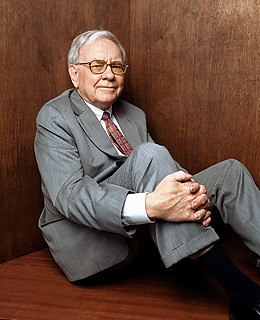
Warren Buffett now says that the backlash from the huge spending that made the recovery possible maybe just around the corner. Writing an Op-ed piece in New York Times, he says: In nature, every action has consequences, a phenomenon called the butterfly effect.


Stop Coddling the Super-Rich
By WARREN E. BUFFETT
Omaha

OUR leaders have asked for “shared sacrifice.” But when they did the asking, they spared me. I checked with my mega-rich friends to learn what pain they were expecting. They, too, were left untouched.

While the poor and middle class fight for us in Afghanistan, and while most Americans struggle to make ends meet, we mega-rich continue to get our extraordinary tax breaks. Some of us are investment managers who earn billions from our daily labors but are allowed to classify our income as “carried interest,” thereby getting a bargain 15 percent tax rate. Others own stock index futures for 10 minutes and have 60 percent of their gain taxed at 15 percent, as if they’d been long-term investors.

These and other blessings are showered upon us by legislators in Washington who feel compelled to protect us, much as if we were spotted owls or some other endangered species. It’s nice to have friends in high places.

Last year my federal tax bill — the income tax I paid, as well as payroll taxes paid by me and on my behalf — was $6,938,744. That sounds like a lot of money. But what I paid was only 17.4 percent of my taxable income — and that’s actually a lower percentage than was paid by any of the other 20 people in our office. Their tax burdens ranged from 33 percent to 41 percent and averaged 36 percent.

If you make money with money, as some of my super-rich friends do, your percentage may be a bit lower than mine. But if you earn money from a job, your percentage will surely exceed mine — most likely by a lot.

To understand why, you need to examine the sources of government revenue. Last year about 80 percent of these revenues came from personal income taxes and payroll taxes. The mega-rich pay income taxes at a rate of 15 percent on most of their earnings but pay practically nothing in payroll taxes. It’s a different story for the middle class: typically, they fall into the 15 percent and 25 percent income tax brackets, and then are hit with heavy payroll taxes to boot.

Back in the 1980s and 1990s, tax rates for the rich were far higher, and my percentage rate was in the middle of the pack. According to a theory I sometimes hear, I should have thrown a fit and refused to invest because of the elevated tax rates on capital gains and dividends.

I didn’t refuse, nor did others. I have worked with investors for 60 years and I have yet to see anyone — not even when capital gains rates were 39.9 percent in 1976-77 — shy away from a sensible investment because of the tax rate on the potential gain. People invest to make money, and potential taxes have never scared them off. And to those who argue that higher rates hurt job creation, I would note that a net of nearly 40 million jobs were added between 1980 and 2000. You know what’s happened since then: lower tax rates and far lower job creation.

Since 1992, the I.R.S. has compiled data from the returns of the 400 Americans reporting the largest income. In 1992, the top 400 had aggregate taxable income of $16.9 billion and paid federal taxes of 29.2 percent on that sum. In 2008, the aggregate income of the highest 400 had soared to $90.9 billion — a staggering $227.4 million on average — but the rate paid had fallen to 21.5 percent.

The taxes I refer to here include only federal income tax, but you can be sure that any payroll tax for the 400 was inconsequential compared to income. In fact, 88 of the 400 in 2008 reported no wages at all, though every one of them reported capital gains. Some of my brethren may shun work but they all like to invest. (I can relate to that.)

I know well many of the mega-rich and, by and large, they are very decent people. They love America and appreciate the opportunity this country has given them. Many have joined the Giving Pledge, promising to give most of their wealth to philanthropy. Most wouldn’t mind being told to pay more in taxes as well, particularly when so many of their fellow citizens are truly suffering.

Twelve members of Congress will soon take on the crucial job of rearranging our country’s finances. They’ve been instructed to devise a plan that reduces the 10-year deficit by at least $1.5 trillion. It’s vital, however, that they achieve far more than that. Americans are rapidly losing faith in the ability of Congress to deal with our country’s fiscal problems. Only action that is immediate, real and very substantial will prevent that doubt from morphing into hopelessness. That feeling can create its own reality.

Job one for the 12 is to pare down some future promises that even a rich America can’t fulfill. Big money must be saved here. The 12 should then turn to the issue of revenues. I would leave rates for 99.7 percent of taxpayers unchanged and continue the current 2-percentage-point reduction in the employee contribution to the payroll tax. This cut helps the poor and the middle class, who need every break they can get.

But for those making more than $1 million — there were 236,883 such households in 2009 — I would raise rates immediately on taxable income in excess of $1 million, including, of course, dividends and capital gains. And for those who make $10 million or more — there were 8,274 in 2009 — I would suggest an additional increase in rate.

My friends and I have been coddled long enough by a billionaire-friendly Congress. It’s time for our government to get serious about shared sacrifice.

Warren E. Buffett is the chairman and chief executive of Berkshire Hathaway.

What do you see outside?


Francis Bacon, Study for Bullfight No 2 (1969)
I think that man now realizes that he is an accident, that he is a completely futile being, that he has to play the game without reason. [...] You see, all art  has now become completely a game by which man distracts himself (Bacon-Sylvester, Interviews, pp. 28,29).


I have signaled the descent of our western system, based on economic liberalism and democracy projected to global proportions, since before its 2008 Crisis.  After three years, during which governments have saved the capitalists by imposing austerity on the populace, we are semi-officially in a 'Small Depression' according to Paul Krugman.  The ordering belief must be that in a world distracted from facts, the capitalists are the only ones to be trusted to {harness, muster, unleash, ...} {creativity, innovation, renewal, growth...}; indeed, capitalists are always selected according to their being best able to align self-interest with action, the best indicator of a well-running capitalist engine, that is.  Stimulating the economy by placing money in the hands of the populace, yours and mine, mostly increases the trade deficit--I have written this too.  Problem is that capitalists are known to buy imports too, unless they park the money in some unproductive niche. 

So, what's a government to do anymore?  A cynical may say that those populating governments are merely interested in preserving class privileges while subsidizing a nice show.  While that is true, can you think of a way out?

For example, the French and Italians citizens thought that by electing economically-liberal demagogues, growth would be assured.  I am skeptical Berlusconi or Sarkozy fulfilled any of their electoral promises.  I am equally skeptical of Cameron's prospects in the UK.

Could it be that we need to take a half-step back from globalization?  Taxing the incentive out of the financial speculation can certainly help.  This addresses in part the flexibility of capital, and the question becomes, how flexible ought capital to be?  For example, Simon Johnson, MIT professor and former Chief Economist of IMF, is not the only to suggest a tax on “excess leverage;" Tobin taxes are also quick to come to mind.   Then, shouldn't we reconsider the French idea for a reduced work load for all, thus being able to employ more?  Yes, we must also get adjusted to the idea that floating is better than sinking, while not as fun as swimming.  In the end, I don't care much about the extent to which these ideas are in agreement with one's standard of free-market capitalism, for I remind you, what we've had so far hasn't been free-market capitalism either. Don't you also find it problematic that each time one tries to argue for active management of the situation, the capitalist (ventriloquist)  counters that due to the complexity of the system, the self-adjustment capability of the markets, free of regulation and taxes, is better than any one's fallible mind? 

In any case, the above ideas are neither of the left, nor of the right.  They are about the art of living and reflecting upon it not long thereafter. 

+
It's most regrettable what happened in Oslo.  I have a feeling that just blaming Anders Behring Breivik is not going to deter forever another symptom of our common disease.  Breivik seems to have been against multiculturalism, whatever that meant in his case beyond being anti-Muslim immigration as a new form of Marxist internationalism--I know, it's a mouthful and I could use some European help to unpack it.

Shock and/or incomprehension, ensuing the massive destruction inflicted by World War I on so many, was not enough to prevent fascism or Nazism from coalescing as reaction to the dissolution of the world order, perceived then by the former as the result of the centrifugal forces of communism and/or international finance.   

As wise people have always said, and the demagogues exploited to i/a-mmoral ends, humans need to believe in something greater than, say, self-interest.  That something had better be based on moral law.  Replacing sacred religion with the secular religion of self-interest, briefly introduced as part of a moral code based on natural law by Adam Smith,  has not worked too well.  As for how religion is observed in the US, let me just say, per out tax code and all that, it's big business for a minority and of whatever comfort for most--read this last statement in terms of effectiveness.


Through my Window(s), I see Tauoromachia.  


What do these youth know and the world hasn't figured out yet?
Do the police know whom they are con/fronting, as in interfacing?
Is democracy the legitimate monopoly of power?  What makes it no longer so?
When humanism is lost, do we regress to homo homini lupus?  How do we come back?


Obama's put option

NYTimes has a piece on the weak economic recovery:

Economy’s Woes Shift the Focus of Budget
By JACKIE CALMES
Recent signs that the economic recovery is flagging have introduced a new tension into the bipartisan budget negotiations.

The general assumption, which I have not shared, is that the money handed to banksters was meant to stimulate economic recovery to pre-2008 levels.  I argued here that our non-bubble economy has shrunk and people become unskilled to the point that the trillions spent by Bush and Obama could only be intended to prop the status qvo ante. Why are people looking for reversing a trend? Because they were told so.  Like in the past, except that our money is increasingly perceived as mostly backed by paper, by those who push gold above $15oo or switch from dollars to other currencies.

After the .com bubble there has been little in terms of sustainable economy that could use stimulus. Let's not forget, bubble money went into the real-estate and war economies. This had taken place while the effects of offshoring were masked by cheap (also subsidized) imports.

Some wake up now and ask for stimulus, yet others in the world have been awake, at least since the crisis in 2008. The latter are not willing to finance us anymore, hence the difficulty of dancing round the deficit vs. stimulus opposite poles.

I think those who fight deficits aim at accomplishing several things, of which one is ignored in the current debate: the external credibility of our system. I'm afraid that's been eroded and we are only seeing how people take calculated steps away from US. The recent Libyan episode is but an incomplete exception, which may itself prove to be temporary.

So, while I can understand why there isn't and won't be a stimulus, I cannot understand why
  1. People expect more stimulus, though it takes one to learn; 
  2. People like Krugman call for more stimulus, since he's a learned man;
  3. The burden is not equally shared. By this, I mean the absence of higher taxation at the top, as in progressive tax.  A VAT system, excluding those items that the lower income people depend on, may also be an option.
What are we afraid of? That everybody with money is going to start learning Chinese? I'm more apprehensive about Geithner's keeping his job, for he is Obama's put option on the status qvo.

________________
A version of this has been posted at the NYTimes blog.

Good summary from blogosphere

The Truth About the Bailout

There’s so much information (not to mention “information”) about the big banks, the Bailout regime, and the financialized economy the banks and government constructed and now use as the vehicle of tyranny.

How to process it all? How to separate the good information from the bad, the useful from the pointless, the truth from the lies? How to weaponize each idea, anecdote, and piece of data?

Here’s a list of criteria which are true and, I think, useful.

1. The big banks caused the crash. They hold the overwhelming responsibility for a Tower of Babel which was bound to come down and is bound to come down again. Any other responsibilities are trivial. The proximate causes are irrelevant.

2. The Bailout artificially props up insolvent banks. But in spite of their phony profits, the banks remain collectively insolvent, and most if not all of them individually so. Every cent they gamble and loot comes directly or indirectly from the Bailouts, from free QE money, from the TBTF premium. It’s ALL taxpayer money. The big banks are now permanent wards of the state. We the people OWN them once and for all, and are free to do anything we want with them, the moment we are inclined to do so.

3. The Bailout accomplishes no socially valid end, but only enables the banks to reopen the casino.

4. The Bailout only intensifies monopoly concentration, which lay at the core of the Too Big To Fail extortion dilemma. (The policy of TBTF only helps confirm the structure in a positive feedback loop.)

4A. (Wealth and power concentration in themselves are anti-democratic, socially and economically destabilizing, and morally perverted.)

5. The finance sector is a purely rent-seeking monopoly. We can place pretty much anything it does on the list of feudal tactics. Every cent they extract is a TAX upon us. All their “innovations” are con jobs, and all their lobbying is bribery and extortion. Rentier Wall Street is the driver of all federal government policy, with the corporatist government serving as a functionary, a conduit, and as a goon.

6. No true reform will be legislated thanks to corruption. We can extend this: The system is so corrupt beyond redemption that there will never be constructive major legislation again. All major bills will be Potemkin at best (like the finance “reform” bill is looking to be), or a further assault (like the health racket bill). In either case they will only seek to further entrench the rackets oppressing us.

7. Anything which is legislated will not be enforced thanks to corruption and capture. We can extend the principle: The law itself is a battleground, and the rule of law in great jeopardy.

8. We don’t need the big banks for recovery, for lending, for international competition, for anything else. All the evidence is that smaller banks provide the real value here, while big banks are not only unable and unwilling to engage in constructive action themselves, but their monopoly power actively hinders the smaller banks.

9. The size of the banks runs counter to our need for a decentralized economy with greater resiliency and robustness. The stimulus has been remarkable for how little money has headed in a constructive direction. This is because of the banks.

10. Only the rich have benefited from the Bailout. Only they will continue to benefit. Everyone else is prey.

11. The banks (and therefore the Bailout) fund the permanent war, which in turn militarizes the country for the benefit of the banks.

12. The stock market is the terrorist wing of finance monopoly. Its purpose is to punish all public interest government action (for example letting the market work in Lehman’s case, or the Congressional rejection in the first Bailout vote). Such punishment is a tool of disaster capitalism, generating the sense of immediate crisis, the Shock Treatment, to terrorize and stampede policy-makers, the media, and the public into allowing or enabling the power and loot grabs.

(On the other hand, it rewards official crime. Thus health insurance stocks have been a barometer of the policy debate on health reform, for example going up after every racket-friendly action on Obama’s part.)

Appendix: The mainstream media’s coverage is systematically biased in favor of corporatism, often atrociously so. The infrequent good articles are accidents, incidental to the media project.

The Bailout is a war upon America. This is Bailout Nation, Bailout America. (We should settle on a name for this debased regime, this perversion of America.)

The basic principles of freedom and humanity tell us that the only measures of an economy’s health, practically and morally, is how well it empowers the people of a society to produce real goods and services for themselves, and how many good jobs it empowers them to create and preserve for themselves.

No other metric has any inherent validity, and nothing else as far as money flow has any value. The rest is just a shell game.

These truths dictate the right positive principle, relocalization, and the necessary negative principle, anti-corporatism. the need to smash the banks. For we are at war.

The call – Smash the banks! Break up Too Big to Fail! Too Big to Fail is Too Big to Exist.

Of any policy we must ask first, What will it do to help Smash the Banks? Of any alleged leader or would-be leader: Where is their call to relocalize? And what have they done to help Smash the Banks?

rene

most look for the past, the lucky seize the moment, the very few look round the corners

At the thinking person level, the economy is mostly a narrative line or another. Sometimes, we feel like joining narratives, yet the ideologues in charge with economic policy would have none of that. This would matter only little had the economic narratives remained constrained to the space of ideas. But economic narratives drive policy and passions, they commingle dialectically with reality.

Looking ahead, in normal times, consists of plotting the dominant narrative in some future, accounting for those kind of medium-term foreseeable changes one can come up with. Our time does not allow such comfort.

The biggest challenge to our capitalist storyline is WAR--assuming no natural cataclysm. I am not taking about war with Iran, though most any war can turn into WAR. Such capital event can be imagined as the result of tension-escalation between a overly sensitive incumbent, magnifying some real or perceived wound, and an incumbent.

I wonder if a renewal of the US Congress with new faces can bring about lawmakers who are more aware of our grassroots-vulnerabilities, -possibilities, and -opportunities. Today, most people in Congress resemble too much the Soviet Politburo in the last years of Brezhnev.

Another challenge, against which the State started preparing after 9/11, is internal unrest. Lacking a support system and facing structural unemployment for years to come, the American fabric may be wearing thin. The legalization of the illegal immigrants can fuel the State for a while longer.  Nothing is guaranteed, though.  Indeed, think of the leaked names and addresses of the illegal immigrants in the state of Utah.  For one, from Utah hail many a patriot, this being the top contributor state to the US Army.  For another, such list could only come from inside the power enforcing mechanism...  Just as Bradley Manning, who also came from inside the power enforcing mechanism.

If we make it through, the big challenge becomes in structuring a post-capitalist society. Can we get so productive and have such a progressive tax system to (sustainably) land in post-capitalism? To those wishing a return to capitalism I can only say that it's tardy late, unless we are ready to lock ourselves in and wait for about two decades until we can achieve some level of self-sustainability.

In closing, I feel like I also need to stand in for today's elites. If a new world order were to happen things might go on for a few more decades. Several managed crises will be necessary, provided that the sense of injustice won't be too high/widespread. Again, the keyword is "managed."

P.S. At a time I used to be more optimistic I authored "Open Letter, for O8." It was a 7-point summary of what I thought we needed at the time Obama and McCain were presidential candidates in 2008.  I think President Obama has done more or less about most points with one exception, Let wages converge lower;  I have to say that this is the direction we are moving towards, and the slowness of getting there is commensurate only with the size of the task itself.  No easy there! 

the voice of big business

Especially at a time like this, views from the commanding heights of American business are a necessity.

Ivan G. Seidenberg, Chairman of the Board and Chief Executive Officer
Washington, DC - June 22, 2010


As Delivered

[Introduction by David Rubenstein, President, Economic Club of Washington.]

Thank you, David, and good afternoon, everyone. Thank you for the very nice introduction. It's very nice to be here this afternoon. The Economic Club of Washington stands at the intersection between policy and business, which is where my Business Roundtable colleagues and I spend a good deal of our time these days. Based on your invitation list I see you've had a number of business leaders here recently to give their prescriptions for putting the U.S. back on the path to growth.

So in my remarks this afternoon I will try to add to this same conversation today. But first, I'd like to tell you a bit about Verizon and the enormously exciting industry we're in.

Before I start though, I might be the only speaker to encourage you to stay on your Blackberries. It's good for business.

Today, almost 2 billion people - about a quarter of the world's population - are connected to the Internet. Twice that many - 4 billion people - have mobile phones, which are themselves becoming smarter and more connected every day. On Verizon's networks alone, we carry more than 1.7 billion text messages, 50 million picture and video messages, 1 billion phone calls, 400 million emails and the equivalent of 4 million full-length movies - all in a single day.

Verizon invests some $17 billion a year to put ourselves in the center of this expanding marketplace.

We operate Internet backbone networks that serve as the digital trade routes for the global economy. We're reinventing our legacy backbone telephone networks around fiber technology capable of delivering 100-megabit capacity directly to customers' homes. In wireless, we operate 3G networks across the country. Later this year, we'll start to roll out our fourth-generation wireless network, which will increase data speeds by up to 10 times and initiate the era of the "Internet of things." Soon, wireless will be embedded in everything we touch, infusing intelligence into all our systems and presenting us with a whole new way to run a home or an enterprise, or even a country.

When it comes to innovation in communications, the U.S. has a clear, decided edge. The smart phone revolution is centered in the U.S. The creation of tens of thousands of wireless applications is a U.S. phenomenon. Our 4G LTE networks - 4th generation networks - will leapfrog the world in wireless. Verizon alone has deployed more fiber-to-the-home than all the countries of Europe, combined. And a new ecosystem of devices, applications and operating systems is coming together around these platforms for innovation, spawning new businesses and driving our industry forward.

America's communications companies have made a big bet on this vision of the future, investing around $130 billion in 2009 alone. Last year, total investment in information and communications technology accounted for an astonishing 43 percent of all non-structural capital investment in the U.S. And while private investment in general fell by almost 23 percent from 2006 to 2009, communications investment rose by almost 9 percent over the same period.

These investments are a major engine of our economy. Businesses report that every dollar invested in Internet technology creates four dollars of value in return. Robert Crandall of Brookings says broadband investment can produce more than half a million new jobs over the next five years, while creating new demand for computers, software, network equipment and applications. And on a global basis, one study estimates the annual economic benefits of the commercial Internet to be $1.5 trillion - more than the global sales of medicine, investment in renewable energy and government R&D investments, all combined.

Broadband, wireless and global IP are at the heart of American competitiveness. At Verizon, we're excited about the future and believe - fervently - that our industry can continue to play a big role in addressing the challenges we face as a country.

Now, it's important that we not throw sand in the gears of this critical growth engine. You may have seen that last week the Federal Communications Commission began a proceeding to establish a new regulatory regime for broadband, which would impose old utility-style regulation on the Internet. We are very concerned that, in attempting to address legitimate issues about access to the Internet, the FCC has proposed basically an unimaginative and overbearing set of rules that essentially tries to retrofit a new industry into an old framework and expand their regulatory reach well beyond what is necessary. As we've said - and as we've demonstrated - communications companies will continue to work with the Commission and the other players in the Internet space to protect customers and ensure an open and robust broadband environment. The FCC's current course of action will really do little to achieve those objectives, but rather will cause uncertainty in the marketplace, create disincentives for investment and make one of the true success stories of the American economy less competitive on the global stage.

***

Now, Competitiveness is also on the minds of the 170 members of the Business Roundtable, which, as David said, I am the chairman. Together, Business Roundtable companies generate more than $6 trillion in revenues and employ more than 12 million people. We account for 60 percent of all corporate taxes, 60 percent of all charitable contributions, and one-half of all private R&D spending in the U.S. Our market capitalization is one-third of the total value of the stock market, and we pay some $167 billion in dividends to individual investors, pension funds and retirement accounts. For every person employed by a BRT company, there are two more employed by the medium and small businesses that supply the goods and services that we need to keep our businesses running.

So obviously, the companies of the Business Roundtable have a huge stake in the success of the American economy. We create jobs all along the food chain. We invent and manufacture and sell the things consumers need. And we have the technology, expertise and capital capacity to play a huge role in contributing to our nation's economic growth.

It should be equally obvious that our collective resources are not being sufficiently engaged.

The BRT has accepted our responsibility as partners in moving the country forward. My colleagues and I have worked closely with policy-makers across the political spectrum on matters from health care to trade and tax policy to energy and climate change. But frankly, we have become somewhat troubled by a growing disconnect between Washington and the business community that is harming our ability to expand the economy and grow private-sector jobs in the U.S. We see a host of laws, regulations and other policies being enacted that impose a government prescription of how individual industries ought to be structured, rather than produce an environment in which the private sector can innovate, invest and create jobs in this modern global economy.

In our judgment, we have reached a point where the negative effects of these policies are simply too significant to ignore.

In the search for short-term revenue fixes, we're doing long-term damage to growth.

By reaching into virtually every sector of economic life, government is injecting uncertainty into the marketplace and making it harder to raise capital and create new businesses.

Meanwhile, without a sufficiently comprehensive focus on growth and jobs, our unemployment rate continues to hover close to 10 percent. The CBO says debt will rise to 90 percent of G.D.P. in 10 years. And last month's job report showed the private sector creating only 41,000 jobs, a figure the Economic Policy Institute says is "nothing closely resembling the job growth needed to dig us out of our very deep hole."

So, from our perspective, it's time to refocus public policy on creating the conditions that will drive private-sector jobs.

Recently, in response to a request from Dr. Peter Orszag of the OMB, the Business Roundtable and the Business Council polled our members about laws, rules and regulations that are inhibiting growth. We summarized our concerns in an extensive report, which we have already delivered to OMB, and I am very much encouraged that the Administration has already reached out to us to set up a process for discussing recommendations and ideas and set the discussion for the future.

From the avalanche of examples included in our OMB submission, let me share some specifics in three categories: taxes, trade and financial reform.

***

One message we heard loud and clear from our members is that the current U.S. tax system is a major impediment to international competitiveness. Our corporate tax rate is the second highest among 30 OECD nations. We're one of only five OECD countries to tax companies on worldwide income. Moreover, since 1990 every other OECD country has lowered its corporate tax rates, while the U.S. is going in somewhat the opposite direction.

Recently, the House passed a tax extender bill containing several provisions that raise taxes on multinational companies. We believe these actions would impair America's competitiveness and harm American workers. Multinational companies account for 63 million jobs, nearly half of U.S. exports and most of the productivity gains in the U.S. economy - facts that need to be taken into account when making tax policy.

Sometimes the problem isn't too much action, but too little. Dividend taxation is one example. Next year, unless the Congress takes action, the tax on dividends is scheduled to rise to that of ordinary income, with rates topping out at 39 percent. On its face, this may seem to be an easy revenue-raising idea. But at a time of extreme market volatility, do we really want to disadvantage stable, dividend-paying stocks - and the retirement funds and millions of long-term dividend investors who depend on them?

Another area in which we fear good intentions will have unintended consequences is financial reform. Clearly, the government has an interest in ensuring a stable financial system, efficient capital markets and ethical and transparent business practices. That's why the BRT completely supports the idea of financial reform. However, we believe some of the current proposals with respect to derivatives and proxy access go a step too far, imposing one-size-fits-all solutions on highly dynamic and diverse businesses. Instead of focusing on the inputs to a transparent and efficient financial system, the proposed reforms will increase risk and volatility at a time when just the reverse is required.

We also see a disconnect between objectives and actions in the area of international trade. The Administration has indicated its intent to double U.S. exports over the next five years, recognizing that with 75 percent of the world's purchasing power and 87 percent of its growth coming from outside the U.S., an export-focused trade policy will grow jobs here at home.

The Business Roundtable agrees wholeheartedly with this goal. But while the European Union is moving ahead in implementing free trade agreements, we have seen very little movement on pending agreements with Colombia, Panama and South Korea to name a few. Nor have we made it a priority to seek more expansive trade negotiating authority to keep up with foreign competitors.

We also could do more to make America a more attractive destination for foreign direct investment, which fell by nearly 60 percent from 2008 to 2009. Now, to be fair, much of that is due to the global recession. But the truth is, the U.S. share of global capital inflows has been declining for decades. A new survey by Ernst & Young found that, whereas 48 percent of global investors saw North America as a desirable location for investment in 2006, by 2010 this percentage had fallen to just 22 percent. The most attractive market is China, favored by 39 percent. To quote the Ernst & Young study, we're competing for capital in a "new multi-polar world"in which investors can shop the globe for "growth, talent, technology and productivity."

We need to make sure that the U.S. isn't a fly-over zone when it comes to international trade and investment.

***

These are just a few of the issues we have laid out in our response to Dr. Orszag's request. The full report contains literally hundreds of separate actions and decisions that, taken together, create an increasingly hostile environment for investment and job creation here in this country.

As I said before, it would be better to re-focus public policy on creating private-sector jobs. In general, among BRT CEOs there is remarkable consensus around a few fundamental pillars to achieve this growth.

First, we need tax policies that promote capital formation. As Fred Smith, CEO of FedEx, noted recently in the Wall Street Journal, the correlation between domestic job growth and business investment is very strong. He calls for an extension of accelerated depreciation tax provisions as a way to give an immediate boost to the economy. According to the Institute for Policy Innovation, every $1 of tax cuts devoted to accelerated depreciation generates about $9 of growth in G.D.P.

Second, we need to increase exports and improve our international competitiveness. Here, the rhetoric from policy-makers has been right but the actions need to be better aligned through an emphasis on trade agreements, corporate tax reform and other initiatives to put us on more competitive footing internationally.

Third point, we need infrastructure investment to create jobs and build the platforms for 21st century growth. Jim Owens, the Chairman and CEO of Caterpillar, points out that since the 1970s, U.S. investment in infrastructure has grown at only half the rate of G.D.P. growth. Roads and bridges are in disrepair and the power grid is inefficient. In particular, we need to upgrade our transportation and energy systems with communications and information technology to create "smart"grids that will radically improve efficiency and productivity. You've heard the story before. Some of this will take public investment, but most can be done by the private sector, if we don't impose so many rules and regulations that it becomes an uneconomic proposition.

The fourth area is education. We fully support the Administration's actions to shore up America's educational system, particularly in science, technology, engineering and math. Verizon is directing more than $25 million this year from our charitable foundation this year to support education, working with partners like the New York Hall of Science, the National Academy Foundation, Jobs for America's Graduates and the many educational partners in our on-line educational resource, Thinkfinity.org. This is also a top priority for the Business Roundtable, which is leading a business-wide initiative to increase the number of American students with college degrees in STEM fields.

And the fifth area of Business Roundtable's CEO focus, we need to promote the innovation and entrepreneurism that are the beating heart of the economy. While the government has a lot of innovation initiatives, we need better focus and coordination in this vital arena. We need a permanent tax credit for research and development, more effective protection for intellectual property, and sustained federal investment in basic research. Both government and private sectors have a critical role to play here. Now, government invented the Internet, mapped the human genome and developed GPS technology - extraordinary advancements. But it took private industry to commercialize these discoveries, develop real businesses around them and make them available to average Americans. There are many areas, from renewable energy to transportation to homeland security protections, where government and industry can and should be working together to develop the technologies that will create new industries and new jobs. To do that, though, we need a more favorable environment for investment and new business formation.

The BRT believes that these five areas - capital formation, exports, infrastructure, education and innovation - are the necessary inputs for creating growth and private-sector jobs. We also believe that, if we can focus on the big goal and stop trying to micromanage industries, we could make real progress in these areas immediately by taking some of the pragmatic, targeted actions I just mentioned.

As further evidence of our commitment to being a good partner to the public sector, the Business Roundtable is forming an initiative around fiscal reform with the goal of providing constructive suggestions and input to government about deficit and entitlement reform. The single most important step government could take to stabilize the financial markets and create an environment for growth would be to show a real commitment to fiscal discipline and a recognition that sustainable growth will only occur when the private sector - not the government - is expanding.

***

Now clearly we have a lot of work to do. The U.S. Department of Commerce estimates that each $1 billion of capital spending generates about 18,000 new jobs for U.S. workers. This means that if we could stimulate an additional $50 billion in capital spending we could create nearly 1 million new jobs. That same $50 billion in capital would also accelerate productivity growth by one or two basis points a year. Over the past 10 years, U.S. productivity growth has averaged 2.8 percent a year. Raising that by a single basis point -- to 2.9 percent a year -- would raise real incomes for Americans by 1 percent over the next ten years, injecting an additional $200 billion into the economy.

We have so much untapped potential, if we can come together around a pro-jobs economic strategy.

To do that, we need to focus on the inputs required to create investment and private-sector jobs.

We need a world view that embraces engagement abroad to support growth here at home.

Most of all, we need accountable leaders in government as well as the business community who reject the false choices between job creation or deficit reduction, growth or sustainability, serving consumers or investors, managing for the short term or the long term, being profitable or doing things right.

Real leadership isn't about making false choices - it's about finding solutions to real problems.

Every one of us should find it unacceptable that so much capacity for growth is sitting on the sidelines. It's time for us all to raise our game and embrace the power of the private sector that will create real value and real growth for our country. If we work together to unleash the private sector's investment and innovative power, I have no doubt that America can accelerate its competitive footing and lead the world in the industries that will create jobs and raise living standards for many decades to come.

For the US Government view, check this letter from Emanuel&Jarrett

Popular Posts